







How to Efficiently Wash and Re-process Mud-Bearing Gold Ore? Professional Equipment Helps You Improve Recovery Rates
I. Typical Symptoms of Gold Ore Processing and Gravity Separation in Mud-Bearing Ore
Turbid tailings water. Under normal conditions, tailings water from gravity separation should be clear. If muddy ore is not properly washed, the tailings water resembles rice water, with fine silt carrying microscopic gold particles flowing out. If you scoop up a ladleful and let it settle for half an hour, a layer of silt will settle at the bottom—and that\'s where the lost gold lies.
Concentrate grade fluctuates wildly. The concentrate band on a shaking table should normally appear as a distinct black line. When there is too much silt, the table surface becomes a muddy mess, blurring the separation zones. Operators adjust water flow and bed angle based on intuition—what works today may result in a significant drop in grade tomorrow.It\'s not that the operators are incompetent; it\'s that the slurry viscosity changes, and the equipment\'s sorting conditions change accordingly. This is exactly what happened at a placer gold mine in Zimbabwe, where production targets fluctuated wildly within the same shift. After thorough investigation, it turned out that the pressure of the wash water from the ore washer was unstable.
Processing capacity remains low, and equipment gets clogged. Screen apertures become completely blocked, chutes become caked with mud, and jig table surfaces harden—cleaning them up takes half an hour. Some plants increase the water flow, but the faster flow rate makes it even harder to retain fine-grain gold.At a placer gold processing line in Ghana, the designed throughput was substantial, but actual output fell short because the line had to shut down every few days to clean the screens. Upon inspection, it turned out the rinse water for the trommel screen was simply tap water at normal pressure; the clay clumps hadn\'t been dislodged, and the screen openings were clogged with a layer of mud cake.
The recovery rate was stuck at a certain level and wouldn\'t improve. Coarse gold was recovered reasonably well, but there was significant loss of fine gold. Changing the shaking table model didn\'t help either. Since the mud wouldn\'t separate, the fine gold particles were constantly circulating in the slurry. Gravity separation relies on density differences for stratification; when viscosity increases, the density difference is negated, and stratification fails.
The impact of mud content on gravity separation recovery rates follows a gradual pattern: the more mud there is, the more difficult gravity separation becomes, and the lower the recovery rate drops. The extent of the drop depends on the properties of the ore, the size of the gold particles, and the equipment configuration—there is no one-size-fits-all answer—but the trend is clear.
II. Why Is Silt So Problematic?
Clay swells when exposed to water, effectively “trapping” the gold particles. The clay in clay-bearing gold deposits consists primarily of clay minerals such as kaolinite and montmorillonite. When exposed to water, these minerals do not simply settle to the bottom; instead, they swell and disperse, forming a colloidal slurry. No matter how heavy the gold particles are, once enveloped by this colloid, their settling velocity is significantly reduced.When swept by the upward water flow in the jig, the mud-coated gold particles are carried along, leaving them no chance to settle onto the bed.
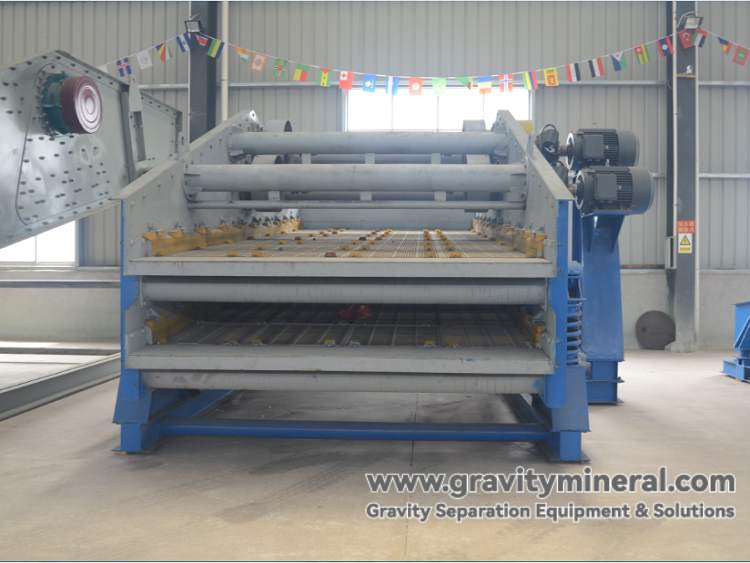
There is a disconnect between ore washing and gravity separation. In many plants, the undersize from the vibrating screen is fed directly into a chute or jig. The small amount of wash water used in the vibrating screen is sufficient for sand but falls far short when dealing with clay. Clay agglomerates that have not been completely broken up slowly disintegrate once they reach the gravity separation equipment, by which point the separation conditions have already been compromised.The correct approach is to include a dedicated de-silting stage between ore washing and gravity separation to control the fine silt content before the ore enters the gravity separation process. This stage is often missing in the ore washing and gravity separation processes for clay-bearing gold ore, and it is the direct cause of low recovery rates.
Fine-grained gold and silt have overlapping particle sizes. Gold particles can be as fine as tens of micrometers, and silt particles are also in the tens of micrometers range. Screens cannot separate them, and gravity separation is difficult as well; the terminal settling velocities of the two cannot be sufficiently differentiated in a viscous slurry.The only solution is to disperse the clay during the ore washing stage, “freeing” the gold particles from the clay aggregates, and then capturing them using centrifugal force or specific fluidization conditions. Ore washing is not merely “rinsing”; it is a process of liberation.Many plants do not take the ore washing stage seriously during the design phase; when production targets are not met, they retrofit equipment, which requires modifications to the site layout and piping.
III. Core of the Solution: Desliming First, Classification Next, Gravity Separation Last
To improve recovery rates in the washing and gravity separation of clay-bearing gold ore, the process involves three key steps: washing away the clay, separating the particle sizes, and ensuring each piece of equipment performs only the task it does best.
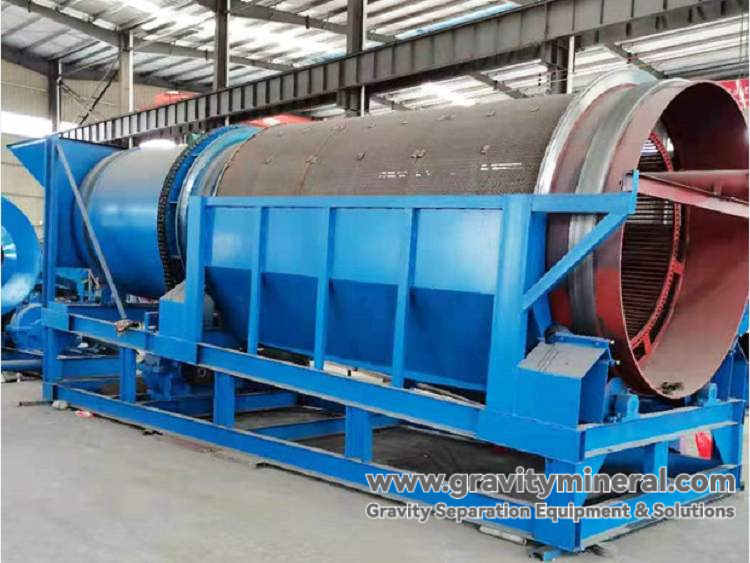
First Stage: Intensive Ore Washing. The cylindrical ore washer is the main unit. Its inclined, rotating drum and internal lifting plates cause the ore to tumble, fall, and rub against one another. The key is the pressure of the wash water—the water must be forced into the ore, not merely sprayed over it. Clay is stripped away by the combined action of mechanical friction and high-pressure water and discharged from the end of the drum.Equipment selection depends on processing capacity and feed particle size. Small- to medium-sized placer gold mines use machines with a diameter of 1.5 meters and a length of about 4.5 meters, processing several dozen to over 100 metric tons per hour; large-scale projects use machines with a diameter of 2.2 meters and a length of 6.5 meters, processing over 100 to nearly 200 metric tons per hour.
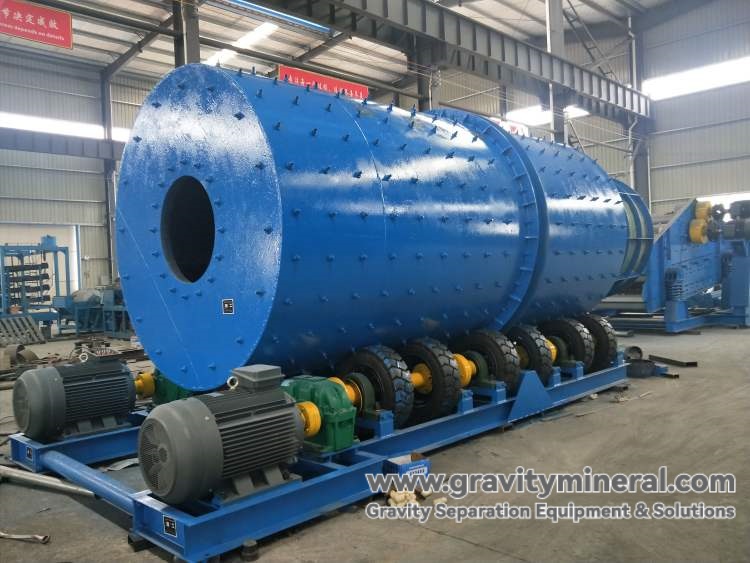
For ore with extremely high clay content—where the slurry forms a ball when squeezed by hand and does not break apart—add a scrubbing machine. Operate the impeller at low speed with a moderately high slurry concentration, and scrub for a few minutes. Do not set the speed too high, as this will disperse the clay further, making it difficult to settle in subsequent stages. Scrubbing is meant to “strip” the clay, not to “crush” it.
Feed particle size must be controlled; the maximum feed size for a cylindrical ore washer is generally 50 millimeters or less. If the raw ore contains large lumps, perform coarse crushing or pre-screening first—do not force them into the machine. At a site in Africa, the discharge opening of a jaw crusher was not properly adjusted, causing large lumps to enter the ore washer and jam it twice; each repair took half a day.
Stage 2: Classification and Desliming. The mud content has decreased somewhat after passing through the ore washer, but it is still insufficient. In gravity separation equipment, if the proportion of fine mud in the slurry exceeds a certain threshold, it interferes with stratification, so a classification step must be added in the middle. Hydraulic cyclones are the most compact option; adjust the feed pressure to the appropriate range, with coarse particles from the underflow entering gravity separation and fine mud from the overflow being treated separately or sent to the tailings.The classification particle size is controlled by adjusting the diameter of the sand discharge nozzle and the overflow pipe, typically ranging from 0.074 to 0.1 millimeters. Medium-diameter hydrocyclones process several dozen cubic meters per hour, making them suitable for small- to medium-sized gold ore washing and gravity separation lines containing silt.
Where water supply is limited or there are specific requirements for recirculated water, a spiral classifier can also be used; however, its classification efficiency is lower, and more fine particles are lost in the overflow. If there is significant loss of fine gold in the overflow, it is more reliable to use a hydrocyclone combined with a thickener.
Section 3: Classification and Gravity Separation. Only when the slurry is “clean” can gravity separation equipment perform at its optimal level.
The coarse fraction (0.5 to 2 mm) is processed by a jig. For coarse particles, use a long stroke with a low stroke rate, and control the bed thickness within an appropriate range; if the bed is too thin, coarse gold will not be retained, and if it is too thick, fine gold will not pass through.The pulsation curve of a sawtooth-wave jig is more reasonable than that of a traditional sine wave, offering greater adaptability to a wide range of particle sizes. With jigging areas ranging from a few tenths to several square meters and processing capacities from several metric tons to 20 metric tons per hour, this is sufficient for roughing operations in small and medium-sized plants.
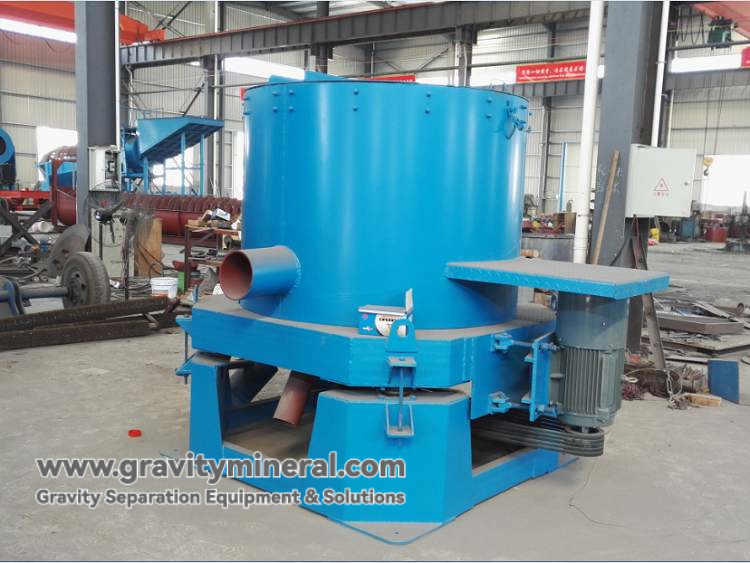
For the fine grain size range of 0.074 to 0.5 millimeters, feed the material to a centrifugal concentrator or spiral chute.The centrifugal force field of a centrifuge is significantly more effective at recovering ultrafine gold than a traditional shaking table; feed concentration should be moderate, and centrifugal intensity adjusted to the appropriate level. Although the concentrate yield is low, the grade is high; the concentrate is sent directly to smelting or processed separately.
Shaking tables are used for final concentration. The feed particle size ranges from 0.02 to 2 millimeters; the slope, transverse flushing water, stroke, and stroke rate are adjusted on-site.The 6-S shaking table has a processing area of 7.6 square meters, with a maximum feed size of 0.074 millimeters, a stroke length of 16 to 22 millimeters, and a stroke rate of over 200 revolutions per minute. Coarse sand and fine slime are processed on separate table surfaces. Shaking tables offer great operational flexibility, provided the feed has a low slime content; otherwise, no matter how the parameters are adjusted, the result will be a muddy mixture.
Only after completing these three stages does the gold ore beneficiation process—which involves washing and gravity separation—truly separate the “silt” from the “gold.” It\'s not about a single piece of equipment handling everything; rather, it\'s about allowing each piece of equipment to operate under its optimal conditions.
IV. Sequence of Implementation
Don\'t rush to replace equipment right away. If recovery rates are low, buying a new shaking table or installing a new centrifuge will cost money without improving performance. The problem lies in the ore washing stage; replacing equipment in the separation stage is useless.
Step 1: Measure the mud content. Take a representative sample of the raw ore, screen out the large chunks, and perform wet screening to determine the percentage of particles smaller than 0.074 millimeters. Then take another sample from the slurry after washing and measure it. The difference between these two figures is a true reflection of the washing efficiency. If the fine silt content remains high after washing, the washing stage is the weak link—start by addressing this area.
Step 2: Check the flushing water pressure. Connect a pressure gauge to the spray hose—don\'t rely on guesswork. At many plants, the flushing water is simply low-pressure tap water, which works for sand but is ineffective against clay. Replace the pump or install a pressure booster to increase the water pressure. This is a minor adjustment, but the results are immediate.At a placer gold mine in Sudan, after installing a booster pump, the amount of mud clumps at the discharge port of the cylindrical ore washer decreased significantly, and the layer on the downstream jig became much more stable; recovery rates began to rise as early as the second week.
Step 3: Install a hydrocyclone between the washing and gravity separation stages. If the undersize from the washing process goes directly into a chute, insert a set of hydrocyclones in between; the underflow goes to gravity separation, and the overflow goes to the thickener.The investment is modest—a medium-diameter unit costs tens of thousands of yuan—but it is the key to linking “washing” and “concentration.” Without it, no matter how well the washing machine performs, fine silt will still be carried away. In gold ore processing flows involving silt-bearing ore, this is one of the most cost-effective modifications.
Step 4: Divide the gravity separation section by particle size. Do not let a single shaking table handle the entire particle size range. Coarse particles should go to the jig, fine particles to the centrifuge or spiral chute, and the shaking table should be used only for fine selection. In high-performing plants, the flowchart for the gravity separation section will always clearly define the different stages, with each handling a specific range.A placer gold processing line in Ghana is configured as follows:The undersize from the trommel screen goes to a hydrocyclone for desliming; the underflow proceeds to a sawtooth jig for roughing; the jig concentrate goes to a 6-S shaking table for fine selection; the jig tailings go to a spiral chute for scavenging; and the fine slurry overflow goes to a centrifuge for recovering ultrafine gold.After running the entire line, the recovery rate has significantly improved compared to before, and the tailings grade has also decreased.
Step 5: Adjust parameters only after the process has stabilized. Only after the ore washing and de-silting processes have stabilized will the feed conditions for the gravity separation equipment become stable. At this point, adjusting the jig stroke and the shaking table slope will yield tangible results with each adjustment. Previous adjustments that showed no effect were not due to incorrect parameters, but because the feed conditions were constantly changing.
V. Results and Common Issues
Once the mud content is reduced and the feed conditions for gravity separation are normalized, the recovery rate shows the greatest improvement. In cases where direct gravity separation originally yielded very low recovery rates, adding ore washing and desliming can restore recovery to the levels expected from standard gravity separation.At Old Zhang\'s plant, after adding a scrubber to the ore washing section, implementing desliming with hydrocyclones, and adjusting the classification by combining jigging with shaking tables, the performance indicators began to stabilize in the third week. The recovery rate rose from just over 60 to nearly 80, and the tailings grade was also reduced. He didn\'t replace a single piece of separation equipment; he simply supplemented the process with ore washing and desliming.
For ore with coarser gold particles—where the majority are 0.5 mm or larger—proper ore washing can achieve very high recovery rates for coarse gold. The fine-grain fraction can be captured using a centrifuge, and there is a good chance of achieving a satisfactory overall recovery rate. The exact figures will depend on test data—I can\'t make any guarantees—but the approach is sound.
In terms of costs, a mineral washing and desliming system consisting of a cylindrical washer, a scrubber, and a hydrocyclone—configured to process several dozen to 100 metric tons per hour—requires an investment in the range of 100,000 to 200,000. By raising the recovery rate from a low level to a normal level, the additional gold recovered will pay for the equipment within a short period.The return on investment hinges on the extent of the recovery rate improvement and the duration of stable operation.
At what level of mud content is ore washing necessary? There\'s no one-size-fits-all figure. It depends on whether the tailings water is turbid, whether the concentrate grade is stable, and whether the processing capacity meets standards. If these three indicators are present, the ore washing section should be reviewed.
How do you choose between a drum washing machine and a spiral washing machine? Drum washers have a high processing capacity and are well-suited for ore with high clay content and high viscosity; they are the mainstay for washing gold ore with high clay content.Spiral washers feature a simple design and low power consumption, making them suitable for applications with moderate clay content and lower processing capacities. For ore with high clay content and clay agglomerates that are difficult to disperse, a combination of a drum washer and a scrubber provides more reliable results.
Is a hydrocyclone always necessary after ore washing? It depends on the washing results. If the fine silt content remains high after washing and the feed conditions for gravity separation do not meet standards, a hydrocyclone is required. It acts as a buffer between the washing and gravity separation stages, reducing the fine silt content to a level acceptable for gravity separation—this step cannot be omitted.
How are the jig and shaking table divided in their roles? The jig handles coarse particles and has a high throughput, serving as the roughing stage; the shaking table handles fine particles and offers high separation precision, serving as the concentrating stage. Coarse particles go to the jig, fine particles to the centrifuge or spiral chute, and the shaking table performs the final concentrating. Only by having each stage manage its specific portion can consistent performance be ensured.
Which section should be addressed first when retrofitting an old plant? Start by inspecting the ore washing section. Check whether the flushing water pressure is sufficient, whether the ore washer model is appropriately matched, and whether there is a desliming step in the process. Only after verifying these three points should you decide whether to modify the gravity separation section. Replacing gravity separation equipment without first properly upgrading the ore washing section will most likely result in a waste of money.
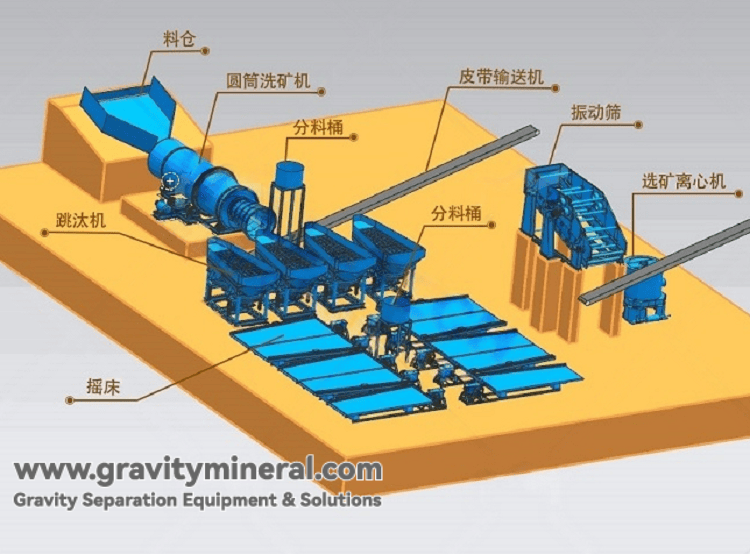
When processing muddy gold ore through both washing and gravity separation, if the recovery rate remains low, the problem almost certainly does not lie with the gravity separation equipment. Start by inspecting the ore washing workshop: check whether the tailings water is clear, whether the screen mesh is clogged, and whether the overflow from the hydrocyclones contains sand. Once these three areas are examined, the source of the problem will generally become clear.
Don\'t rush to replace the shaking table—first, get the ore washing process right. GravityMineral has been in the gravity separation business for twenty years and is highly skilled in manufacturing jigs, shaking tables, and spiral chutes. However, whenever we provide a solution, we are always precise about the size of equipment to use in the ore washing section, the required water pressure, and how to select the hydrocyclones.We manufacture our own equipment, design our own processes, and commission them on-site ourselves—if the ore washing stage isn\'t configured properly, even the best downstream equipment will be useless. In this gold-bearing ore washing and gravity separation line, washing is the root, and gravity separation is the fruit; only when the roots are firmly planted can the fruit bear fruit.