







How to Select a Cyanidation Plant for Gold Tailings Re-processing? Complete Equipment and Process Solutions for Re-processing
Article Overview
-
When selecting a cyanidation plant for gold tailings from gravity separation, the first step is not to choose equipment, but to use test data to determine the occurrence and particle size distribution of gold in the tailings.
-
Equipment in the gravity separation section is configured according to particle size: jigs are used for coarse particles, shaking tables and spiral chutes for fine particles, and centrifugal separators to capture ultrafine particles.
-
The cyanidation stage design is determined by the nature of the tailings: whole-slurry cyanidation, regrinding leaching, and carbon-in-pulp (CIP) each have their own applicable limits, which must align with the production capacity of the gravity separation stage.
-
The core of the entire gravity separation equipment and process design lies in the interface matching and particle size coordination between the gravity separation and cyanidation sections, rather than the performance of individual machines.
-
Mining test results serve as the basis for selecting a cyanidation plant for gold tailings from gravity separation; the test data determine the process flow, equipment list, and production capacity configuration.
Selecting a cyanidation plant for gold tailings from gravity separation is an unavoidable challenge for many rock gold mines following gravity separation. While the gravity separation stage removes coarse-grained free gold, there is often a lack of systematic assessment regarding how to process the remaining gold in the tailings, whether cyanidation is economically viable, and how to configure the equipment.In practice, it is common for companies to purchase gravity separation equipment and construct cyanidation tanks, only to find that the two stages do not integrate smoothly and the performance indicators do not meet expectations. The problem usually lies not with individual pieces of equipment, but rather with a lack of clarity regarding the overall design logic for the cyanidation plant processing gold tailings from gravity separation.
Below, we will clarify the design philosophy for a cyanidation plant processing gold tailings from gravity separation, as well as the key points for configuring the complete set of gravity separation equipment and process solutions, by examining several aspects: ore sample testing, gravity separation equipment selection, cyanidation process design, and the integration of the entire production line.
I. Before Selecting a Cyanidation Plant for Gold Tailings from Gravity Separation, First Understand the Nature of the Tailings
Gravity-concentrated gold tailings are not a standard material. The properties of tailings discharged from different mines and different gravity separation processes vary significantly; simply replicating the design of a cyanidation plant for raw ore often leads to problems. Before selecting a cyanidation plant for gravity-concentrated gold tailings, at least the following factors must be thoroughly understood:
Gold particle size distribution. Gravity separation primarily recovers coarse, free gold in the form of individually liberated particles. The gold remaining in the tailings consists of two types: fine-grained, individually liberated gold that was not captured by the gravity separation equipment, and intergrown gold encapsulated within gangue or sulfide minerals.The former is relatively easy to leach using cyanide, while the latter often requires regrinding or prior enrichment. This directly determines whether a regrinding stage needs to be added to the cyanidation section of the cyanide leaching plant for gold tailings from gravity separation.
Silt content and slurry properties. When the tailings contain a high proportion of fine silt, the viscosity of the cyanide leaching slurry increases, slowing the diffusion of the leaching agent. This requires a longer leaching time and, consequently, a larger leaching tank volume.If a large amount of recirculated water is used in the gravity separation stage, residual reagents and suspended solids in the water may also interfere with the cyanidation process.
Content of harmful impurities. Copper, arsenic, antimony, and carbonaceous matter are the primary interfering factors in cyanide leaching.Copper consumes cyanide, while arsenic and antimony affect leaching efficiency; carbonaceous matter can cause “gold scavenging,” re-adsorbing gold that has already been dissolved. The concentrations of these impurities determine whether the cyanidation stage requires pretreatment or a switch to a combined process.
Where do these data come from? They can only be obtained through mineral processing tests. Tests on gold tailings from gravity separation focus on measuring three sets of data: the distribution of gold across various particle size fractions, the degree of gold liberation, and the curve showing the variation in cyanide leaching recovery with particle size.Once these three sets of data are available, there is a solid basis for determining the required mesh size for the gravity separation stage, whether further grinding is needed in the cyanidation stage, and how to design the overall process flow for the cyanidation plant processing gravity separation gold tailings.
II. Equipment Selection for the Gravity Separation Section: Configure Based on Particle Size, Not a Rigid Template
The reprocessing of gold tailings from gravity separation essentially involves recovering gold that was not captured during the initial gravity separation. The selection of gravity separation equipment depends on two variables: feed particle size and throughput.
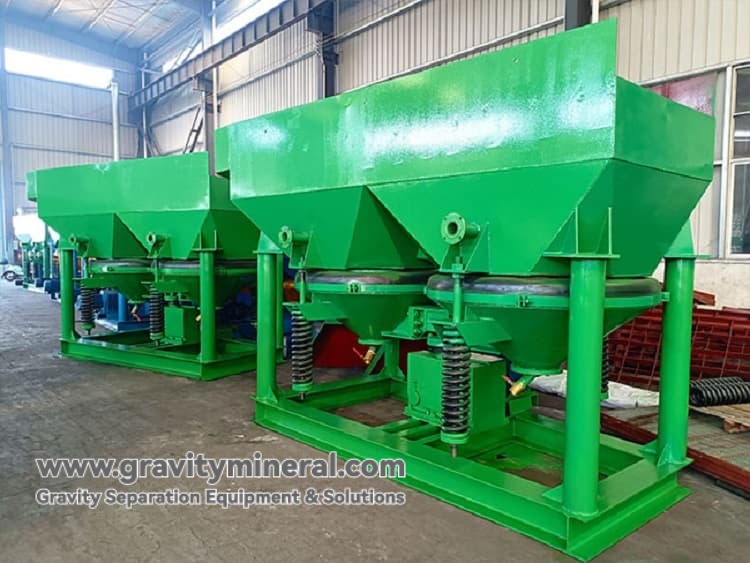
Coarse-grained tailings. When the proportion of coarser grain sizes in the feed is significant, the jig is the primary equipment. Sawtooth-wave jigs are well-suited for materials with a wide grain size distribution, feature a reasonable water flow pulsation curve, and offer high processing capacity per unit area.When coarse free gold is abundant, a jig can be used for roughing to recover a portion of it first, followed by fine selection of the concentrate on a shaking table.
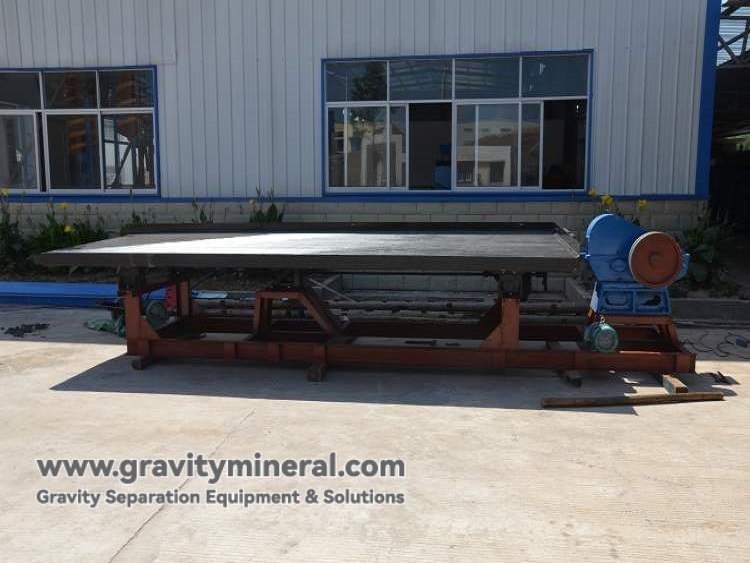
Fine-grained tailings. When the feed consists primarily of fine particles, spiral chutes are used in combination with shaking tables.Spiral chutes have a high throughput and require no power consumption, making them suitable for roughing and tailings disposal; 6-S shaking tables offer high separation precision and are suitable for fine selection. Shaking tables are sensitive to the feed particle size range; mixing coarse and fine particles reduces separation efficiency. Therefore, it is advisable to install a classification stage before the gravity separation section to separate coarse and fine sand for individual processing.
Ultrafine-grain tailings. When the proportion of ultrafine-grain material is high, the efficiency of conventional gravity separation equipment decreases significantly, making a centrifuge a necessary supplement.Centrifugal separation is more effective than shaking tables for recovering fine-grained gold; however, since centrifuges typically operate intermittently and yield low concentrate recovery rates, their capacity must be matched to that of the roughing equipment.
More equipment in the gravity separation section is not necessarily better. Whether to connect several shaking tables or spiral chutes after the jig, and how to further process the coarse and fine concentrates, should be determined by test data. Too many stages can lead to material blockages in intermediate sections; too few result in the loss of fine-grained gold.A mismatch between the processing capacities of the jig and the shaking table is a common issue in the operation of a complete gravity separation system; one end is “underutilized” while the other is “overloaded,” resulting in poor process stability. When selecting equipment for the gravity separation section of a cyanidation plant processing gold tailings, this capacity coordination must be considered in advance.
III. Process Design for the Cyanidation Stage: Integration with the Gravity Separation Stage
After the gravity separation section recovers coarse-grained gold, the tailings proceed to the cyanidation stage. The core of selecting the cyanidation process for a gold tailings cyanidation plant lies in choosing between whole-slurry cyanidation, regrinding and leaching, or the carbon-in-pulp (CIP) process, and aligning it with the capacity of the gravity separation section.
Whole-slurry cyanidation. This is suitable for tailings with a finer particle size and a high degree of gold liberation. The process involves concentration, leaching, washing, zinc powder displacement, or carbon adsorption. Equipment includes leaching tanks, thickeners, filter presses, and desorption/electrolysis equipment.When the particle size of the gravity separation tailings is suitable, feeding them directly into the whole-ore cyanidation process can eliminate the need for regrinding, thereby reducing capital and operating costs.
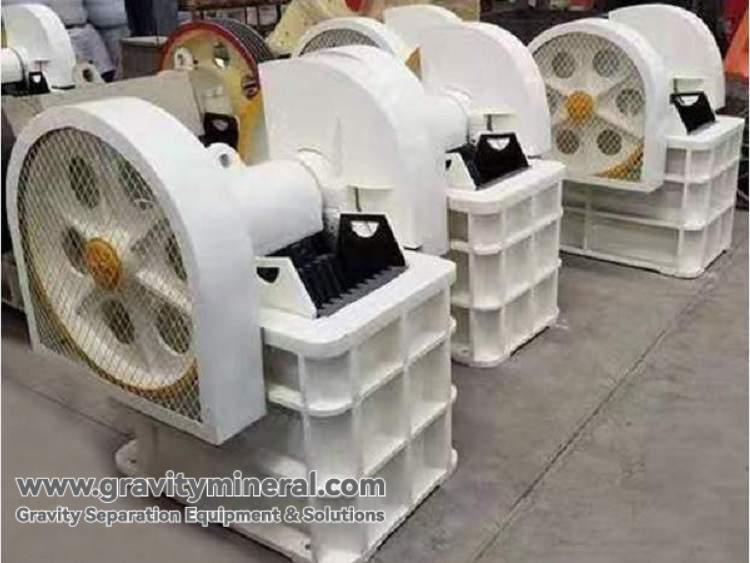
Regrinding and Leaching. Suitable for cases where gold is encapsulated in gangue or sulfide minerals and liberation is insufficient. A regrinding mill must be added; either a ball mill or a rod mill is acceptable, with the rod mill providing better protection against overgrinding of brittle minerals.The target regrinding particle size is determined through testing and is typically one to two grades finer than the original tailings. The cost of regrinding must be weighed against the value of the additional gold recovered.
Carbon-in-Pulp (CIP) and Carbon-in-Leach (CIL). CIP and CIL are the mainstream choices for cyanide processing plants handling rock gold. CIL typically incorporates leaching tanks prior to leaching, allowing for a more thorough leaching period and making it suitable for ores with slower gold leaching rates;CIP leaching and carbon adsorption occur simultaneously, resulting in a shorter process flow that is suitable for ores with faster leaching rates. Equipment includes leaching tanks, carbon separation screens, carbon recovery pumps, and desorption electrolysis equipment. The choice between CIP and CIL for a cyanidation plant processing gold tailings from gravity separation should be determined by leaching rate test data.
Heap leaching. Suitable for tailings with low throughput, low grade, or limited site conditions. It requires lower investment and yields quicker results, but recovery rates are lower than those of tank leaching, and the process is highly susceptible to climatic conditions.
The selection of a cyanidation process cannot be determined in isolation from the gravity separation stage. The process design for a cyanidation plant treating gold tailings from gravity separation is the result of the joint optimization of both the gravity separation and cyanidation stages.
IV. Interface Compatibility of the Complete Gravity Separation Equipment Set: More Critical Than Individual Machine Performance
The equipment list for a cyanide plant processing gold tailings from gravity separation is extensive: feeders, jigs, shaking tables, spiral chutes, centrifugal separators, thickeners, leaching tanks, carbon-in-leach (CIL) tanks, filter presses, desorption and electrolysis equipment, and more.While the performance of individual units may be satisfactory, conflicts in the operation of the entire line often stem from interface compatibility issues.
Aligning Production Capacity. The throughput of the jig, shaking table, thickener, and the volume of the leaching tank must be calculated based on a single set of production capacity data. If the throughput of the roughing equipment does not match the processing capacity of the concentrating equipment, material will pile up or be diverted at intermediate stages, causing the process to run inefficiently.The capacity configuration of the entire gravity separation system should be based on data from integrated process tests.
Particle Size Coordination. The discrepancy between the tailings particle size from the gravity separation section and the feed particle size for the cyanidation section—as well as whether additional grinding is required and the impact of such grinding on leaching—must be clearly calculated during the process design phase.Gravity separation is sensitive to particle size matching, and the cyanidation process also has specific requirements: particles that are too coarse will not leach thoroughly, while particles that are too fine will turn into slurry, affecting leaching. The intermediate classification and grinding stages are critical nodes in the process design of a cyanidation plant processing gold tailings from gravity separation.
Material Flow. Map out the material flow for the entire line, clearly labeling the throughput, particle size, and concentration at each node to identify potential blockages and areas of idle operation. Thoroughly completing this preliminary work is more cost-effective than modifying piping or adding equipment during the commissioning phase.The soundness of the complete set of gravity separation equipment and the process design is ultimately reflected in whether the entire line can operate stably.
V. Mineral Processing Tests: Basis for Plant Selection for Gravitational Gold Tailings Cyanidation Plants
Without test data, there is no basis for selecting equipment for a cyanidation plant processing gold tailings from gravity separation. The tests should cover the following:
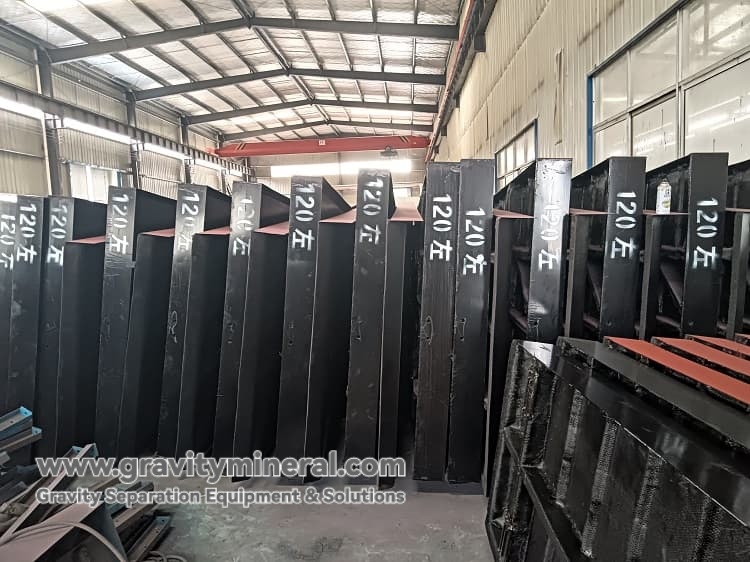
Gravity separation tests: Screen analysis of tailings to determine the distribution of gold across various particle size fractions; gravity separability tests, including conditional tests on jigs, shaking tables, and centrifugal separators to determine their optimal feed particle sizes and recovery rates; and tests on the number of gravity separation stages to determine the configuration of roughing, scavenging, and concentrating stages.
Cyanidation Stage Testing. Leaching condition tests: conduct gradient tests for grinding fineness, sodium cyanide concentration, leaching time, and pH; for the carbon-in-pulp (CIP) process, conduct separate tests on carbon density and adsorption time; tests on the impact of harmful impurities to assess the degree of interference with leaching caused by copper, arsenic, and carbonaceous matter.
Integrated Process Testing. Closed-circuit testing of the entire gravity separation and cyanidation process, with the two stages operating in tandem, to evaluate the final gold recovery rate and tailings grade. This step most closely resembles actual production conditions and serves as the primary basis for equipment selection and capacity matching in a cyanidation plant processing gold tailings from gravity separation.
Thorough testing provides a solid basis for the equipment list and process flow; oversimplified testing results in costs for subsequent process modifications or equipment replacements that far exceed the initial testing investment. Testing costs are typically offset when subsequent equipment or engineering contracts are signed, so this investment should be included in the project\'s preliminary budget.
VI. Coordination Between the Supply of the Complete Set of Gravitational Separation Equipment and the Process Design
If the equipment supply and process design for a cyanide leaching plant processing gravity separation gold tailings are handled by different entities, ambiguities regarding responsibility can easily arise regarding interface parameters (throughput, particle size, and concentration).The supplier of the gravity separation equipment may argue that the feed particle size for the cyanidation section is non-compliant, while the supplier of the cyanidation equipment may claim that the output from the gravity separation section is unstable; this leads to high coordination costs and a prolonged commissioning period.
A more prudent approach is to select a supplier where the same team handles both the manufacturing of the gravity separation equipment and the process design.Core gravity separation equipment—such as jigs, shaking tables, spiral chutes, and centrifugal separators—is manufactured at the supplier\'s own facilities, while supporting cyanidation equipment—such as leaching tanks, carbon-in-leach (CIL) tanks, and desorption/electrolysis equipment—is supplied concurrently. Process design and equipment selection are handled by the same team of engineers, ensuring that interface compatibility and production capacity alignment are fully guaranteed.
GravityMineral\'s approach to projects such as gravity-recovered gold tailings cyanidation plants is as follows: gravity separation equipment is manufactured at our own facilities, while mineral processing tests, process design, equipment selection and configuration, and plant layout are completed by our in-house team, ensuring that the interfaces between the gravity separation and cyanidation sections are aligned during the design phase.Our equipment is exported to more than 50 countries and regions, and we have accumulated a track record of combined gravity and cyanidation projects for rock gold ores; our experience in adapting to different ore properties is available for reference.
If you have samples of gold tailings from gravity separation, you may first send them to us for mineral processing tests. Once the test report is available, it will provide a clear basis for determining the configuration of the gravity separation section, the integration with the cyanidation section, and the calculation of the complete equipment list and production capacity.When selecting a cyanidation plant for gold tailings from gravity separation, the most prudent approach to managing investment risks is to first thoroughly understand the ore properties before determining the equipment and process.
VII. Frequently Asked Questions
The gold grade in gravity separation tailings is not very high. Is it worth proceeding with cyanidation?
This should be determined based on test data. If the cyanide leaching recovery rate is high and the value of the recovered gold can cover the leaching costs, the conditions for cyanide leaching are met; if the leaching recovery rate is low and the content of harmful impurities is high, flotation enrichment or pretreatment should be considered first, as direct cyanide leaching may not be economically viable. The test report serves as the basis for this calculation.
Should a jig or a spiral chute be used in the gravity separation section?
It depends on the particle size.If coarse particles predominate, use a jig, as it handles large throughput and achieves better recovery of coarse gold; if fine particles predominate, use a spiral chute for roughing combined with a shaking table for fine selection, which is lower in cost and suitable for discarding tailings at higher throughput rates. It is also common to use a combination of both: jig for roughing, spiral chute for scavenging, and shaking table for fine selection, with the number of stages determined by testing.
How to choose between the carbon-in-pulp (CIP) and carbon-in-leach (CIL) processes?
CIL provides a longer leaching time and is suitable for ores with slower gold leaching rates; the CIP process is shorter and requires slightly lower capital investment, making it suitable for ores with faster leaching rates. The selection is based on leaching rate tests, which measure the percentage of gold dissolved over a specific period.
How long does it typically take for a cyanide leaching plant processing gold tailings from gravity separation to go from contract signing to production?
A typical turnkey mineral processing project takes seven to twelve months, including buffer periods for equipment manufacturing, ocean freight logistics, on-site installation and commissioning, and customs clearance. It is more prudent to plan ahead and allow for sufficient margins rather than rushing the schedule.
Is it feasible to retrofit an existing plant by replacing only the gravity separation section equipment?
It is feasible, but a process diagnosis must first be conducted to determine whether the bottleneck lies in the gravity separation section or the cyanidation section. Upgrading the gravity separation equipment will increase processing capacity; however, if the leaching time in the cyanidation section is insufficient, performance indicators may actually decline. The retrofit plan should evaluate the entire line to avoid focusing solely on a single stage.
When selecting equipment for a cyanidation plant processing gold tailings from gravity separation, it ultimately boils down to one thing: using test data to thoroughly understand the properties of the tailings, configuring gravity separation equipment based on particle size, selecting a cyanidation process based on those properties, and then aligning the production capacities and particle size interfaces between the two stages.The rationality of the entire re-selection equipment and process scheme is not reflected in individual machine parameters, but rather in whether the entire line can operate stably and whether performance indicators can meet expectations. The more effort invested in testing and process design during the early stages of a re-selection gold tailings cyanidation plant project, the greater the certainty of successful commissioning later on.