







How to Select Gold Recovery Reagents for Gravitational Concentrates? A Guide to Gravitational Separation Process Designs and Reagent Selection
Choosing the right gold extraction agent for gravity concentrate is one of the most easily underestimated aspects of a gravity separation process. Many processing plants have their gravity separation sections running smoothly and achieve respectable concentrate grades, but they hit a roadblock when it comes to leaching—leaching rates won\'t go up, and chemical consumption per unit of concentrate won\'t go down.The answer to how to select a gold extraction agent for gravity concentrate isn\'t found in chemical brochures, but rather in the properties of your ore, its particle size distribution, and your leaching conditions.Below, following a five-step approach—“Problem—Cause—Solution—Implementation—Result”—we will clearly explain how to select gold extraction reagents for gravity concentrate and thoroughly discuss the corresponding reagent regimens within the gravity separation process.
I. Problem: Concentrate Grade Has Increased, but Leaching Efficiency Has Stalled
Does your plant face this situation as well? The gold grade of the gravity concentrate produced by the Nelson or shaking table appears much higher than that of the flotation concentrate. However, as soon as it enters the leaching process, the problem becomes apparent.
Typical findings on lab reports show that while the concentrate grade is not low, the leach residue grade often remains stuck in the range of 10 to 20 g/t, and the leaching recovery rate hovers between 85 and 90 percent—barely rising during good periods and failing to even maintain 85 percent during poor ones.Based on a daily processing capacity of several dozen metric tons of gravity concentrate, the amount of metal left in the tailings over the course of a month is no small figure.
Even more of a headache is reagent consumption. Some plants use sodium cyanide, with reagent usage reaching two to three kilograms per metric ton of ore—costs are uncontrollable, and environmental regulators are keeping a close eye on them every day.Switching to environmentally friendly gold extraction agents presents another challenge: the market is flooded with a wide variety of brands. One claims to be “a viable substitute for sodium cyanide,” while another boasts “higher leaching rates than cyanide.” But when tested, some result in a sharp drop in leaching rates, while others fail to deliver results even when the dosage is doubled.Choosing the right gold extraction agent for gravity concentration concentrates has become a major hurdle in the leaching process.
You might think the chemicals aren\'t up to par, but the real issue is that you haven\'t figured out exactly what works best for gravity concentrate. In a gravity separation process, selecting the right gold leaching agent is never an isolated step.
II. Reason: The “Temperament” of Gravity Concentrates Differs from That of Flotation Concentrates
When leaching rates for gravity concentrate remain low, the root cause often lies not in the reagents themselves, but in three easily overlooked factors. Understanding these is a prerequisite for selecting the right gold leaching agent for gravity concentrate.
First, the particle size is relatively coarse, and the gold particles are not fully exposed.
Gravity concentrate is separated by gravity, so the particle size of gold grains and their associated gangue is inherently coarse. In Nelson concentrate, gold grains ranging from tens of micrometers to hundreds of micrometers are common, and in some cases, visible gold particles can even be observed. If this material is fed directly into the leaching tank, the reagent solution cannot penetrate into the interior of the gold grains.It is standard practice for 90% of flotation concentrates to be ground to -0.074 mm, but what about gravity concentrates? Many plants simply feed them directly into the leaching tanks, skipping the regrinding step altogether. With gold particles coated by gangue or sulfides, the leaching reagents cannot penetrate, and leaching rates naturally remain low.
Second, the “major reagent consumers” in gravity concentrate have not been effectively controlled.
Gravity concentrate has a high grade, and the impurities it contains are highly concentrated. Sulfides, arsenic minerals, and carbonaceous matter all compete with gold for reagents in the leaching system.This is especially true for carbonaceous gold ores: the organic carbon concentrated in the gravity concentrate directly adsorbs dissolved gold complexes, creating the illusion that “the gold is leached out only to be reabsorbed.”You may see that the leaching recovery rate isn\'t improving, but in reality, the gold has already dissolved and was then reclaimed by the carbon. In this situation, switching to any other gold leaching agent is futile; you must first suppress the interference from the carbon. In the gravity separation process design, impurity pretreatment and the selection of the gold leaching agent are considered together.
Third, the choice of gold extraction agent does not match the properties of the ore.
Environmentally friendly gold extraction agents are not a one-size-fits-all solution.Some reagents work well on oxidized ores but fail completely when applied to sulfide ores; others are suitable for whole-ore leaching but require higher dosages when used for concentrate leaching. Even with the same batch of ore, changing conditions will alter performance metrics. The selection of a gold extraction reagent for gravity separation concentrates must be tailored to the specific ore—you cannot simply copy someone else\'s reagent list.
The root of the problem isn\'t where you\'re looking. You\'re focusing on the unit price and brand of the reagents, but what you really need to look at are these three factors: concentrate particle size, impurity composition, and leaching conditions. This is also why the gravity separation process design and the selection of gold extraction reagents must be designed in tandem.
III. Solution: Three Steps to Select and Use the Right Gold Extraction Agent for Gravitational Concentrates
Don\'t rush to switch reagents. First, follow the three steps below to thoroughly understand the fundamentals before deciding what to use and how to use it. This approach applies to most scenarios involving the selection of gold extraction reagents for gravity concentrate.
Step 1: Conduct a “Health Check” on the Gravity Concentrate.
Take a representative sample and perform three tasks.
First, perform sieve analysis. Examine the particle size distribution of the concentrate: determine the proportions of particles smaller than 0.074 mm and larger than 0.15 mm. If the proportion of coarse particles is too high, regrinding is necessary.If the gravity concentrate is re-ground until particles smaller than -0.074 mm account for at least 85 percent, the leaching recovery rate will typically improve significantly, with the exact extent depending on the ore\'s properties. In most cases, the cost of regrinding is justified by the additional gold recovered.
Second, analyze the impurities. Focus on the sulfur, arsenic, carbon, and copper content. High sulfur indicates an abundance of sulfide minerals, which consume more oxygen and reagents during leaching; high carbon requires considering the addition of inhibitors or switching to other gold extraction methods; high copper competes with gold for complexation, so reagent dosage must be increased.
Third, conduct comparative leaching tests. Don\'t be put off by the effort—take three to five different reagents and perform parallel leaching tests using the same batch of concentrate and the same set of conditions. Use sodium cyanide as the baseline and eco-friendly reagents for comparison.Record the leaching recovery, tailings grade, and specific reagent consumption for each reagent at its optimal dosage. With the data laid out, it will be immediately clear which reagents perform well and which do not. This is the most critical basis for selecting a gold extraction reagent for gravity-concentrated ore.
Step 2: Narrow down the choice of reagents based on ore type.
Based on the test results, match the ore type to the appropriate reagent.
For oxidized gravity concentrate—which contains few sulfides and has low carbon content—most eco-friendly gold extraction reagents are suitable. The key is to focus on the optimal dosage and leaching time for each reagent.Some eco-friendly reagents achieve high leaching rates even at low dosages, while others require 1.5 to 2 times the sodium cyanide equivalent dosage to be effective. Choose the one with “moderate dosage and stable leaching rates”; don\'t opt for higher-dose options just to save money, as the overall cost will actually be higher.
For sulfide-type gravity concentrate, which has a relatively high sulfur content, high reagent consumption is an unavoidable challenge. Prioritize reagents with strong tolerance to sulfide interference. Adding lime to adjust alkalinity before leaching, combined with a small amount of leaching aid, will help keep the dosage of eco-friendly reagents within a reasonable range and stabilize the leaching recovery rate.If your concentrate has an even higher sulfur content, you\'ll need to increase the dosage; conduct small-scale tests first to determine the upper limit.
Carbon-bearing gravity concentrate is the most problematic category. Carbonaceous materials adsorb dissolved gold and must be addressed as a priority. Either pre-treat the concentrate with kerosene or activated carbon before leaching to passivate the carbon, or select a reagent system that inhibits carbon adsorption.The accumulation of organic carbon in high-carbon gold ore flotation concentrates has a very direct negative impact on leaching. If your concentrate has a high carbon content, we recommend performing carbon pretreatment before leaching; do not expect the gold extraction agent alone to handle it. When selecting a gold extraction agent for gravity concentration concentrates, it is especially important to resolve the carbon issue first in carbon-bearing ores.
Step 3: Determine the chemical regimen and lock in the parameters.
Once the reagents are selected, the next step is determining their application.
Dosage: With eco-friendly gold extraction agents, more is not necessarily better. Some plants, fearing insufficient leaching rates, add excessive amounts of reagent, resulting in saturation of the reagent in the pulp—any excess is simply wasted.First, conduct dosage gradient tests to identify the inflection point where “the leaching rate no longer increases significantly.” Set the production dosage slightly above this inflection point to allow for a margin of safety.
Alkalinity: Adjusting the pH to 10.5–11 with lime is standard practice. However, caution is needed with gravity concentration concentrates: adding too much lime can form a calcium film on the surface of gold particles, which actually hinders dissolution. Adding the lime in two stages—adjusting half before leaching and supplementing the other half midway through—yields better results than adding the entire amount at once.
Leaching aids: If the leaching recovery rate is stuck at 90% and won\'t increase, consider adding leaching aids. Substances such as potassium ferrocyanide and sodium peroxide require only small amounts but yield significant results. Conduct small-scale tests first; if effective, scale up to production.
Liquid-to-Solid Ratio: For leaching of gravity concentrate, a liquid-to-solid ratio of 2.5:1 to 3:1 is appropriate. If the slurry is too thick, mass transfer is poor; if too thin, the reagent concentration cannot be maintained. Do not simply adopt parameters used for whole-ore leaching, as leaching of concentrate is entirely different from whole-ore leaching.
| Ore Type | Reagent Approach | Key Control Points | Dosage Reference |
|---|---|---|---|
| Oxidized Concentrate | Conventional Environmentally Friendly Gold Leaching Agents | Re-grinding fineness, pH stability | Determined based on the inflection point from pilot-scale tests, with a 10%–15% margin |
| Sulfide-type Concentrate | Sulfur-tolerant reagents | Lime for alkalinity adjustment and leaching aids | Determine the upper limit via pilot testing; add in stages |
| Carbon-bearing concentrates | Carbon suppression system or pretreatment | Carbon passivation; staged dosing | Determine reagent dosage after pretreatment |
IV. How to Implement the Plan: From the Lab to the Leaching Tank
Once the pilot test is complete and the data looks promising, don\'t rush to roll it out plant-wide. Follow this sequence for a steady approach. This implementation process is itself an integral part of the gravity separation process plan.
Week 1: Streamline the regrinding process. If testing reveals the particle size is insufficient, perform regrinding first.Since the volume of gravity concentration concentrate is small, a small grinding mill or one connected in series with an existing mill will suffice. Once the target fineness is achieved, take samples for sieve analysis to confirm that the proportion of particles smaller than -0.074 mm meets the standard. If this step is skipped, all subsequent efforts to fine-tune the reagent formulation will be in vain.
In the second week, conduct reagent comparison tests. Using the regrind concentrate, run at least three test groups: a sodium cyanide reference group, and candidate eco-friendly reagents A and B.For each group, run several dosage gradients and take samples at two time points during the leaching process. Record the leaching rate curves to identify the optimal dosage range for each reagent. The laboratory data from this step will serve as the basis for your future reagent procurement and will directly inform the selection of leaching agents for gold recovery from gravity concentration.
Week 3: Proceed to production validation. Select a leaching tank and process a batch under the optimal conditions identified in the pilot test. Before feeding, analyze the concentrate grade and impurities; during leaching, take samples at specific time points to measure gold concentration; and after leaching is complete, analyze the leach residue.If the results do not match the pilot test data, investigate three areas: whether the grinding fineness has resulted in coarse particles, whether the lime dosage is accurate, and whether the reagents were added uniformly. Lime is the most common source of issues in production; manual addition versus belt feeding results in significant differences in precision.
Week 4: Standardize operating parameters. Record the reagent dosages, pH range, leaching time, and liquid-to-solid ratio from the validation batch on an operating card and post it in the leaching section.Review these during shift handoffs to ensure the night and day shifts are on the same page. If indicators fluctuate erratically, it\'s almost always because the operating parameters haven\'t been strictly enforced.
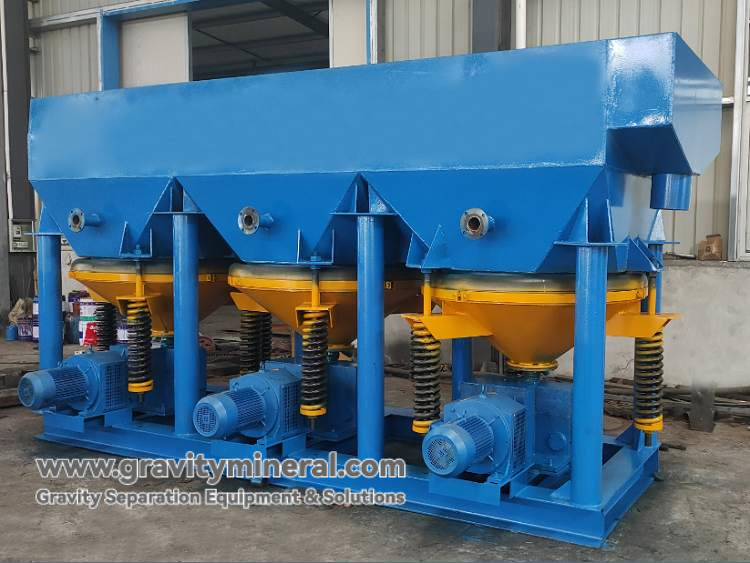
Speaking of implementation, there\'s one point worth mentioning. The leaching process for gravity-concentrated ore—from regrinding, alkali adjustment, and reagent addition to leaching—doesn\'t involve many steps, but the equipment selection and coordination for each step require careful consideration.Teams like GravityMineral, which specialize in gravity separation, design gravity separation solutions for rock gold ores by incorporating a jig into the grinding circuit to capture coarse gold early on, and connecting the gravity separation tailings directly to the leaching tank. The entire gravity separation process—from feed to dewatering—is configured as a single integrated line, with equipment interfaces and production capacity perfectly aligned.Whether you\'re building a new line or retrofitting an existing one, partnering with a team that specializes in both gravity separation equipment and process design can help you avoid the pitfall of “buying equipment that doesn\'t integrate properly.” Of course, the choice of gold extraction agent for the gravity concentrate ultimately depends on your own ore sample data.
V. How Effective Is It? Let the Data Speak—But Don\'t Be Too Categorical
To what extent can performance indicators improve by following this method? The figures provided here represent typical industry ranges; specific results for your plant will depend on the properties of your ore and on-site conditions.
Leaching Efficiency: For oxidized gravity concentrate, where more than 85% is regrinded to -0.074 mm, leaching efficiency typically improves significantly when paired with a suitable, environmentally compliant gold leaching agent. The extent of improvement depends on the ore properties, with most projects seeing gains in the range of a few percentage points.Conditions for sulfide concentrates are slightly more demanding, but through the coordinated adjustment of alkali levels and leaching aids, a steady increase can still be achieved. Carbon-bearing concentrates also have room for improvement if pretreatment is carried out properly.
Leach residue grade: Where the gold grade in leach residue was originally high, it can generally be reduced by a significant margin through regrinding and optimization of the chemical regimen. The specific extent of the reduction is directly related to the gold particle distribution in the original ore and the compatibility of the chemicals.
Chemical Costs: The unit price of environmentally friendly gold extraction agents is typically higher than that of sodium cyanide; however, with proper control of usage, the overall cost may not necessarily be higher.The key factor is whether the revenue generated by improved leaching recovery can offset the difference in reagent costs. Most plants can recoup the additional costs associated with the reagent switch within a few months; the specific payback period depends on gold prices and ore grade.
| Metric | Before Adjustment (Typical) | After Adjustment (Expected) | Description |
|---|---|---|---|
| Leaching Rate | 85 to 90 | Stable with a slight increase | The range depends on the properties of the ore |
| Leach residue grade | 10s to 20s g/t | Significant decrease | Depends on regrinding fineness and reagent compatibility |
| Chemical cost per metric ton of concentrate | Benchmark | Some increases, some decreases | Overall costs reflect leaching efficiency gains |
| Overall Profit | Baseline | Net Increase | Payback Period Varies by Project |
It should be noted that the ranges listed above are not guaranteed values. The selection of gold extraction agents for gravity concentrate ultimately depends on the inherent characteristics of the ore—density difference, particle size distribution, and association patterns. The rigorous approach is to conduct pilot tests first and make decisions based on your own data.
VI. Key Considerations for Selecting Gold Extraction Agents in Gravitational Separation Process Designs
The selection of gold extraction agents for gravity concentrate cannot be considered in isolation from the gravity separation process scheme. The following key considerations are frequently raised by customers during the selection process.
The interface between the gravity separation stage and the leaching stage. Since gravity separation recovers coarse-grained gold early on and the tailings are subsequently sent to leaching, controlling the particle size at this interface is critical.If the gravity separation stage produces too coarse a product, it places a heavy burden on the leaching stage; conversely, over-grinding in the gravity separation stage leads to losses due to sludging. A reasonable approach is to integrate gravity separation equipment into the grinding circuit to recover early-recoverable gold and reduce over-grinding.
Selection of regrinding equipment. For regrinding gravity concentration concentrate, rod mills are more suitable than ball mills, as they minimize over-grinding of brittle minerals. The grinding fineness should be based on the single-particle liberation of gold particles; finer is not necessarily better.
Pre-treatment before leaching. For concentrates with high sulfide content, ensure adequate alkali adjustment prior to leaching; for concentrates with high carbon content, perform carbon passivation first. Thorough pre-treatment broadens the range of available gold extraction agents and makes dosage control easier.
Uniformity of reagent dosing. For concentrates with low leaching volumes, the precision required for reagent dosing is actually higher. Manual dosing leads to significant fluctuations; where feasible, implement automatic dosing or at least use metering pumps to prevent wide variations in specific reagent consumption.
Tailings treatment and environmental compliance. When selecting gold extraction reagents with environmental considerations in mind, evaluate not only leaching efficiency but also the treatment costs for tailings and wastewater. Some reagents may offer excellent leaching performance but result in complicated tailings treatment; the overall costs must be calculated comprehensively.
VII. Common Misconceptions and Self-Check List
When selecting gold extraction agents for gravity concentrate, there are several common pitfalls worth avoiding in advance.
Misconception 1: Skipping regrinding and switching reagents directly. If the particle size is insufficient, no reagent can remedy the situation. Check the fineness first, then discuss reagent selection.
Misconception 2: Comparing only the unit price of reagents without calculating the total cost. A reagent with a low unit price may require double the dosage, and the leaching rate may not necessarily be higher. Calculations must include the total reagent cost per metric ton of ore plus the revenue from the leaching rate.
Misconception 3: Blindly copying someone else\'s reagent formula. Since ores vary, the reagent regimen must be redefined. Others\' successful experiences should only serve as a reference—they cannot be copied directly.
Misconception 4: Neglecting the pretreatment of impurities. If high sulfur content isn\'t corrected by adjusting alkalinity or high carbon content isn\'t passivated, even the most appropriate gold recovery reagent won\'t be effective.
- Does the -0.074 mm fraction in the concentrate account for at least 85%? If not, arrange for regrinding first.
- Have the sulfur and carbon contents of the concentrate been analyzed? If sulfur or carbon levels are high, develop a pretreatment plan first.
- Have you conducted parallel leaching comparisons using at least three different reagents? If not, conduct the tests first.
- Is lime added in stages, and is the metering accurate? Adding the entire amount at once or relying on manual estimates can cause indicator fluctuations.
- Have gradient tests been conducted for reagent dosages? If not, identify the inflection point before determining production dosages.
- Have the shift\'s operating parameters been standardized and posted on the wall? If not, first create operating cards before discussing stability.
VIII. Returning to the Original Question
How should you select a gold extraction reagent for gravity concentrate? First, screen and analyze the particle size; then, test for carbon and sulfur content; finally, run a set of parallel leaching comparisons. Once you have these three sets of data, you\'ll be able to determine which reagent to use and how to use it with near certainty.In a gravity separation process, selecting the gold leaching agent is part of the leaching stage, but it\'s closely linked to particle size control in the gravity separation stage, regrinding configuration, and pretreatment design. If you isolate the agent selection from these factors, you\'ll often make the wrong choice.
Ultimately, selecting a gold extraction reagent for gravity concentrate comes down to this: “ore properties determine the direction of reagent selection, and test data determine the dosage regimen.” Don\'t rush to place an order—run the tests first.