







How to Solve the Challenge of Gravity Separation of Fine-Grained Gold? A Complete Solution for Enhanced Gravity Separation Equipment
Grab a handful of ore sand from the side of the tailings chute and rub it between your fingers. If it feels slippery and sticky, and the layer of fine silt floating on the water takes a long time to settle, the problem is right in front of you. The gold has gone along with the silt.
The low recovery rate for ultrafine gold in gravity separation isn\'t due to insufficient grinding or equipment running too slowly. It\'s because those gold particles—measuring tens of micrometers or even just a few micrometers—don\'t have time to settle in conventional gravity separation equipment; they\'re carried away by the water flow and end up in the tailings.On the shaking table, the ore bands appear clearly separated, and the grade of the concentrate collected for testing isn\'t bad either; yet when the total recovery rate is calculated, the numbers simply aren\'t satisfactory. The problem lies in the fine-grain fraction—in the portion of gold invisible to the naked eye.
The enhanced gravity separation machine solution is designed to address this loss in this specific stage.
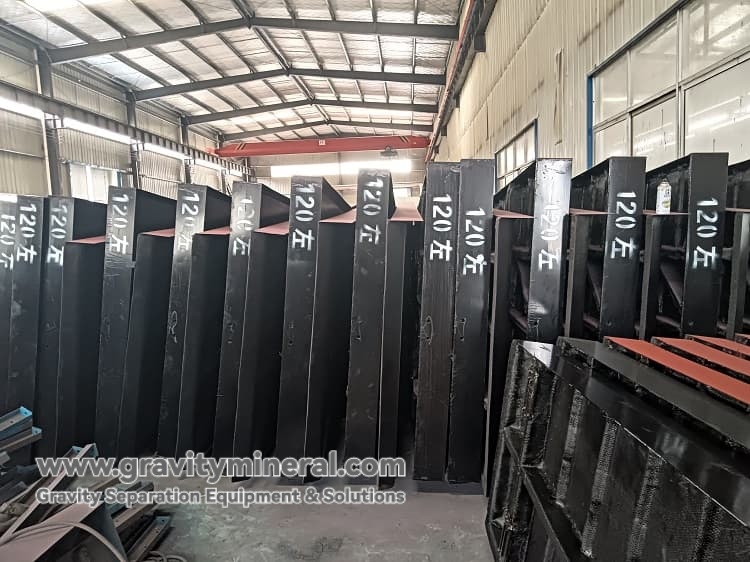
Typical Problems in the Gravity Separation of Ultrafine Gold: At Which Particle Size Does the Gold Escape?
Don\'t focus on the overall recovery rate figure just yet. That number can obscure the real problem.
What you need to examine are: the particle size distribution of the grinding discharge, the concentration of the feed to the gravity separation process, and the state of gold in the tailings. In most plants with low gravity recovery rates, the losses are not evenly distributed across all particle size fractions; rather, they are concentrated in a single narrow size fraction.
This manifests in several ways. The concentrate band on a shaking table narrows; the thin layer of concentrate that should be present on the fine silt side disappears, dispersing as soon as it\'s rinsed with water.The concentrate discharged from the centrifugal separator appears substantial, but upon analysis, the grade is significantly lower than expected, and the enrichment ratio has not been achieved. When panning back through the tailings chute with a gold pan, one can see scattered specks of fine gold, sparkling brightly, yet the gravity separation system simply cannot recover them.
Process mineralogy data from a fine-grained gold deposit in Xinjiang illustrates the issue: fine-grained gold particles smaller than 10 μm account for 35.03% of the total, and 19.62% of the gold is embedded within iron oxides and gangue minerals, making it difficult to effectively liberate under conventional grinding conditions.With a single gravity separation process for this type of ore, it is very difficult to reduce the gold grade in the tailings.
The situation at the Sifang Gold Mine prior to its renovation was similar. The recovery efficiency of fine-grained gold-bearing ore in conventional gravity separation processes was unsatisfactory; it was only through systematic process optimization that the overall gravity recovery rate was successfully improved.
If the gold grade in tailings consistently hovers above 0.3 g/t, it indicates that there are significant gold loss points in the gravity separation process for ultrafine-grained gold.
Troubleshooting: Why Even Upgraded Gravity Separators May Not Solve the Problem
Whenever poor fine-grain recovery is mentioned, many operators\' first reaction is that “the centrifuge\'s rotational speed is too low.” Increasing the speed results in the bed becoming compacted, preventing concentrate discharge and actually causing even more gold to be lost in the tailings.
With enhanced gravity separators, higher rotational speeds aren\'t necessarily better. The root causes usually lie in these three areas.
First, “pseudo-liberated” gold in the ground ore. Under a microscope, it appears as individual particles, but in reality, the gold particles are still attached to gangue or sulfides on their surfaces, which lowers their density. In the centrifugal field, it is just slightly lighter than pure gold—and that slight difference places it right on the boundary between recovery and loss.Data from that mine in Xinjiang is very telling: 61.39% is exposed or semi-exposed native gold, while nearly 40% of the remainder exists in the form of gold encapsulated by sulfides, iron oxides, or gangue. Even with further intensification of gravity separation, the gold trapped within the gangue cannot be extracted.
Second, slurry clogs the bed layer. Fine-grained gold deposits are often associated with large amounts of slurry-prone gangue. Mica and chlorite turn into slurry as soon as they are ground; in the centrifuge, this slurry does not separate by density but moves according to viscosity. The bed layer becomes completely clogged with slurry, preventing backwash water from penetrating, and gold particles cannot sink.At that mine in Xinjiang, the total content of mud-prone gangue was 45.03%, meaning nearly half of the feed material interfered with the separation process.
Third, the classification stage failed to feed the fine particles to the correct location. In many processing plants, both coarse and fine feed are fed into the centrifuge together. The coarse particles occupy space in the bed layer, preventing the fine gold particles from squeezing into the gaps.During the renovation of the Sifang Gold Mine, a dedicated vibrating screen upgrade was implemented specifically to optimize feed conditions and allow subsequent equipment to perform effectively.
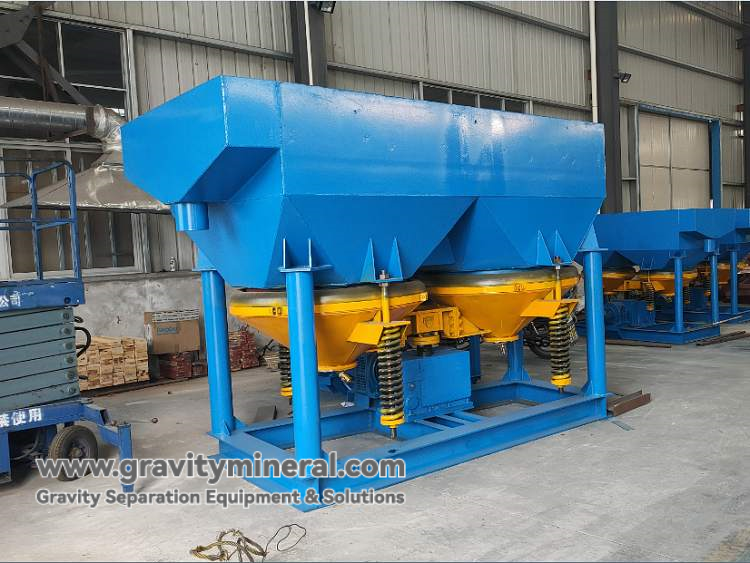
Solution: Configuration and Process Adjustments for the Complete Enhanced Gravity Concentrator System
The solution is not simply to replace the centrifuge with a more expensive model. The core concept of enhanced gravity separation is to use the centrifugal field to amplify density differences, use backwash water to keep the bed loose, and use classification to feed different particle sizes to the appropriate equipment. If any one of these three elements is missing, the effectiveness is compromised.
Two parameters are critical for selecting the main unit. For processing ultrafine gold particles, the centrifugal concentrator is the primary equipment. The key factors are centrifugal acceleration and the backwash water system.Centrifugal acceleration must be increased to at least 60 times gravity to create a sufficient difference in sedimentation rates between gold and gangue. However, do not aim for excessively high values; exceeding the equipment\'s design limits will compact the bed layer, preventing backwash water from penetrating effectively. This causes the concentrate yield to drop, and the enrichment ratio to collapse.For the backwash water system, choose a design with adjustable water pressure and spray nozzles that are resistant to clogging. With some equipment, recovery rates gradually decline after a period of use; upon disassembly, it is often found that half of the backwash nozzles are clogged with calcium deposits and fine silt.
Continuous discharge is more stable than intermittent discharge. Traditional intermittent discharge models stop the machine each time to discharge concentrate, which limits throughput; during the first few minutes after startup, the bed layer has not yet been established, resulting in fluctuating recovery performance.Centrifuges with continuous discharge use automatic control to adjust the discharge port, allowing concentrate to flow out in real time and maintaining a stable bed condition. For the gravity separation of ultrafine gold particles, stability is more important than peak performance.
The process consists of three steps.
Step 1: Desliming. Install a hydrocyclone or desliming hopper upstream of the centrifuge to remove as much ultrafine slime as possible. If slime remains in the gravity separation system, it will result in greater losses later on. The deslimed slime is sent separately to leaching or flotation; it should not be forced into the gravity separation process.
Step 2: Classification and Feed Separation. The feed is divided into two streams: coarse and fine. The coarse fraction goes to shaking tables or jigs, while the fine fraction enters the centrifuge. The mesh size of the classification screen is determined based on ore particle size analysis, not on empirical guesswork.
Step 3: Closed-circuit processing of middlings. The middlings produced by the shaking tables or centrifuges are returned to regrinding to break up agglomerates, ensuring the gold is thoroughly liberated before being returned for reprocessing. While this may appear to increase the grinding load, the reduction in gold loss results in a net gain overall.
Implementation: From the First Week of Sampling to the Third Month of Parameter Stabilization
This plan requires a commissioning period; it does not yield immediate results simply by being implemented.
Week 1: Assess the baseline. Collect three sets of samples: gravity feed, gravity concentrate, and gravity tailings. Perform sieve analysis on each sample to determine the distribution of gold across different particle size fractions. The lost gold is likely concentrated in a specific narrow size fraction, and this data will determine the direction of subsequent adjustments.
First Month: Single-Unit Commissioning.Run the centrifuge independently first. Test feed concentrations from low to high, observing the bed condition and concentrate discharge. The concentrate should flow out as a continuous, watery slurry—neither squeezed out dry nor too thin and watery. Simultaneously, pan the tailings to check for any remaining fine gold.
Second month: Series processing. Desliming and classification are incorporated. Samples are taken from both the overflow and underflow of the desliming hydrocyclone for analysis to confirm that the amount of gold carried away in the slime is within acceptable limits. The classification screen separates out the fine particle size fraction required for the centrifuge. The entire line is run through, though the indicators may still be unstable—this is normal.
In the third month, parameters were finalized. Three parameters—feed concentration, backwash pressure, and centrifuge frequency—were locked in. Shift operation cards were created, clearly specifying the ore type, concentration, and frequency. New shifts followed these instructions rather than relying on intuition to adjust settings.
Equipment materials also require advance consideration. For highly siliceous, abrasive ores, if the flow components are not replaced with high-chromium alloy or wear-resistant rubber, they will wear through within a few months. In acidic environments, corrosion-resistant stainless steel or internal linings must be specified in advance.
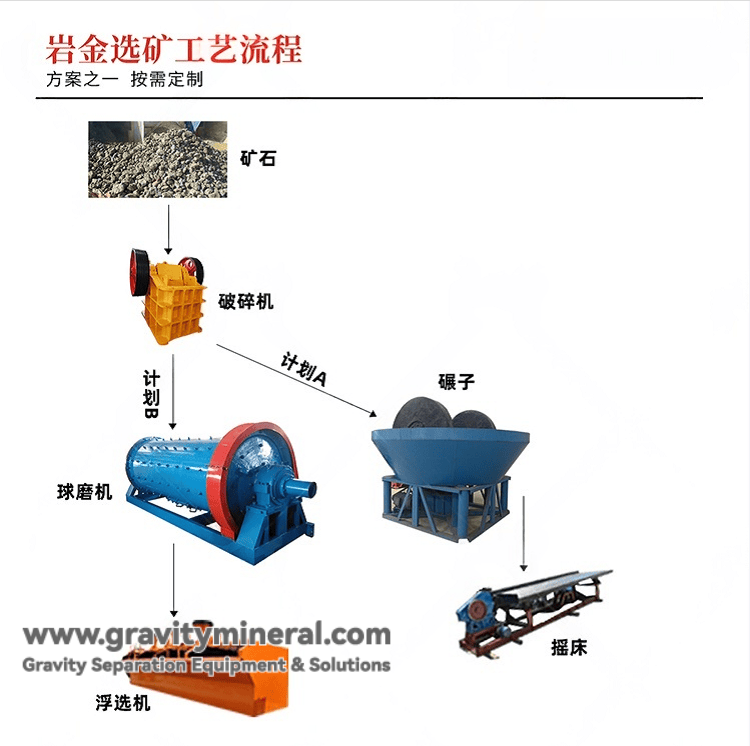
Expected Results: To what extent can enhanced gravity separation improve performance?
At the individual-unit level, industry data confirms the performance improvements of continuous-discharge centrifuges in fine-grain gold recovery: the recovery rate for the -38 μm particle size fraction shows significant improvement compared to traditional batch-discharge models, primarily due to bed stability and timely discharge.
At the system level, the retrofit case at the Sifang Gold Mine is particularly instructive. Their approach involved a combination of “vibrating screen retrofit + regrinding of middles + shaking table replacement + automation upgrade”—not merely replacing a single piece of equipment. Following the retrofit, the comprehensive gold recovery rate of the gravity separation system increased by 4.91 percentage points.When applied to a processing plant handling hundreds of metric tons per day, the cumulative annual metal yield is quite substantial.
It should be noted that the specific improvement depends on the nature of the ore. For ores with a high proportion of entrapped gold, no matter how much the gravity separation process is intensified, the gold trapped within the gangue cannot be recovered.The mine in Xinjiang ultimately achieved an ideal total recovery rate through a combined Nelson gravity separation and whole-slurry leaching process. While enhanced gravity separators are effective for individually liberated fine-grained gold, a combined process is necessary to recover entrapped gold.
There are proven engineering methods to reduce the gold grade in tailings from a relatively high level to a lower one. However, this requires first thoroughly understanding the degree of liberation. If the grinding fineness is insufficient and the gold has not been liberated from the gangue, no centrifuge will be effective.
What Kind of Processing Plants Is This Solution Suitable For?
Not all fine-grain gold gravity separation challenges can be resolved with a single set of equipment. There are several criteria for evaluation.
If the gold in the ore exists in the form of single or intergrown particles, and the proportion of entrapped gold is not too high, the enhanced gravity separation scheme has room to demonstrate its effectiveness. If the grinding fineness has already met or is close to the liberation requirements, and the fine-grain fraction accounts for a significant portion of the feed to the gravity separation process, this scheme has even greater potential for improving efficiency.
If process mineralogy indicates a high proportion of encapsulated gold that cannot be liberated by conventional grinding, gravity separation can only serve as a pre-concentration step, followed by flotation or leaching processes.Kalin-type gold deposits are a classic example: gold is encapsulated in sulfides in an invisible form, so direct gravity separation yields limited results; the sulfides must first be enriched via flotation, followed by pretreatment to release the encapsulated gold.
In cases of severe ore sludging, the design of the desliming stage is more critical than the selection of a centrifuge. If the slime is not properly treated, even the best enhanced gravity separator will become clogged.