







Is the recovery efficiency of alluvial gold deposits low? This gravity separation solution significantly improves recovery rates.
- Target Ore Type: Alluvial gold deposits with relatively high clay content, consisting primarily of fine and ultrafine gold particles that are often cemented with clay
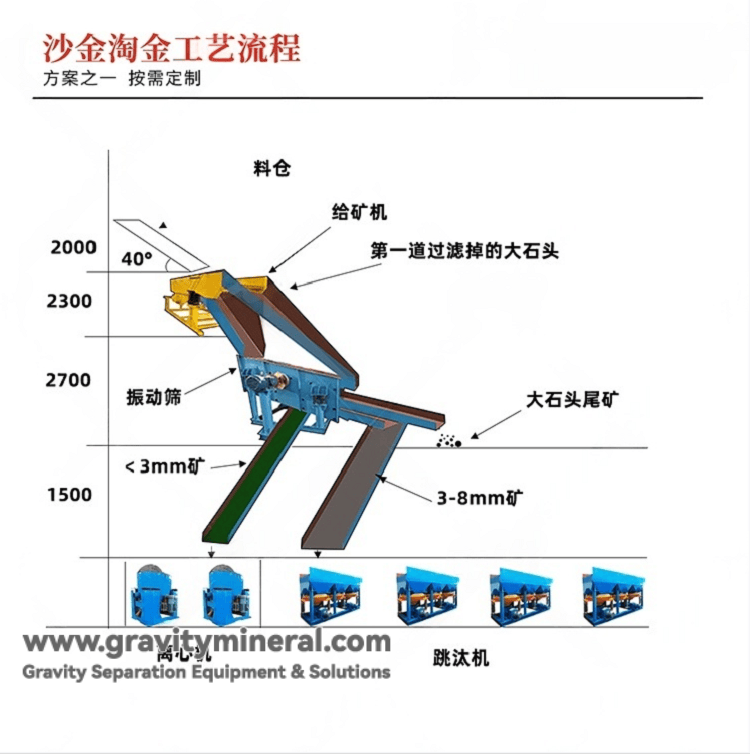
- Core Process: Ore washing and desliming → Agitated chute roughing → Centrifugal concentrator fine selection → Shaking table scavenging
- Key Problem Addressed: Gold particles coated in clay cause abnormal settling, and fine-grained gold cannot be recovered using traditional sluices
- Applicable Scenarios: Alluvial or residual alluvial deposits characterized by dispersed ore bodies, high clay content, and a high proportion of fine-grained gold
- Prerequisites for Assessment: The applicability of this gravity separation scheme for alluvial gold deposits depends on mineral sample test data; it cannot be directly applied based on experience alone
I. What Is This Process?
Key Points: This is a multi-stage gravity separation process that relies on ore washing and desliming as a prerequisite, with the centrifugal concentrator serving as the core for fine-grain gold recovery.
A gravity separation scheme for colluvial gold deposits is not limited to a single piece of equipment but rather refers to a gravity separation process configured in stages according to particle size. It consists of four functional stages—ore washing and desliming, rough concentration, fine grain concentration, and scavenging and purification—connected in series, with each stage processing a specific particle size range without interfering with the others.
The difficulty of processing colluvial gold deposits lies between that of residual deposits and alluvial deposits. While they share the high clay content and insufficient gold particle liberation typical of residual deposits, they also possess the basic conditions required for concentration via gravity separation, as found in alluvial deposits.Applying conventional placer gold processing equipment directly to colluvial gold deposits often results in channel plugging, loss of fine-grain gold in the tailings, and significant fluctuations in processing indicators.
The design logic behind this solution is straightforward: first, break up and wash the clay to expose the gold particles; then, use agitated chutes to recover coarse gold; next, use a centrifugal separator to recover fine and ultrafine gold particles—which conventional chutes cannot capture—in a high-centrifugal-force field; and finally, use a shaking table to produce the concentrate.Each of the four stages handles a specific particle size range, which is the structural reason behind the improved gravity separation efficiency for alluvial gold deposits.
II. What Problems Does It Solve?
Key Points of the Solution: This gravity separation solution for alluvial gold deposits addresses three intertwined challenges; resolving any single one of them in isolation is unlikely to yield significant results.
Alluvial gold deposits generally have a high clay content; clay coats the surface of gold particles, forming a mud film that reduces the density difference between the gold particles and the gangue.Gold particles enter the gravity separation equipment coated with this clay film, causing their settling velocity to deviate from normal values and ultimately resulting in their loss as tailings. Furthermore, clay clumps swell when exposed to water in the chutes, clogging the bed layer and preventing gold particles from entering the bar capture zone. This is the primary cause of low gravity separation efficiency in alluvial gold deposits.
A significant portion of the gold particles in alluvial gold deposits falls within the fine and ultrafine grain size ranges. Traditional chutes and fixed screens have limited recovery capacity for ultrafine particles, which is an inherent shortcoming of the gravity separation process. Although the grade of the tailings may not appear high, the large processing volume results in a cumulative loss of metal that cannot be ignored.
Alluvial gold deposits are typically small in scale, scattered in distribution, and have a limited service life for individual sites. By the time a fixed processing plant has been fully depreciated, the deposit may already have been exhausted. Therefore, equipment configuration for alluvial gold processing solutions must prioritize ease of relocation.
This solution is best suited for alluvial gold deposits with small to medium daily processing capacities, relatively high clay content, a significant proportion of fine-grained gold, and relatively dispersed ore bodies. If the clay content is very low and the gold particles are predominantly coarse, a simple combination of chutes and shaking tables will suffice, and there is no need to adopt this configuration.
III. Core Components and Principles
Key Points of the Solution: This gravity separation scheme for alluvial gold deposits consists of four functional sections arranged in series; the order cannot be altered, as each section addresses the recovery of a specific particle size or state.
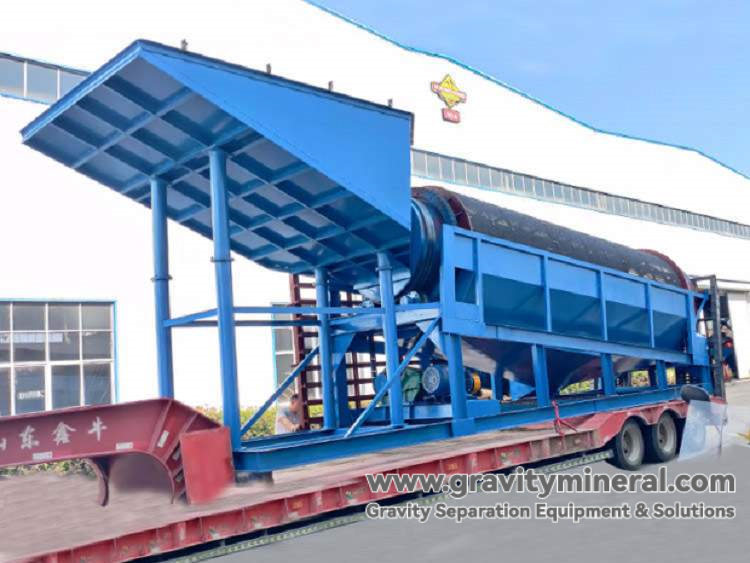
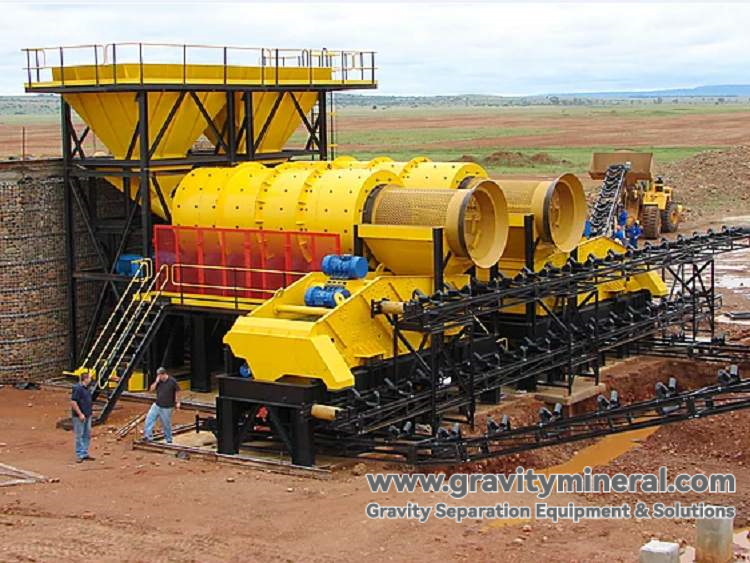
- First Section: Ore Washing and Desliming. This serves as the preliminary stage of the entire alluvial gold ore gravity separation process. The trommel washer uses rotating drum action combined with high-pressure water jets to break up and strip away clay agglomerations.The effectiveness of ore washing directly determines whether subsequent gravity separation stages can operate normally. For ore with high clay content, relying solely on a drum washer is often insufficient; a spiral washer or scrubbing equipment must be added to perform secondary, intensive desliming. If the ore washing stage is not carried out properly, the effectiveness of all subsequent gravity separation equipment will be compromised.
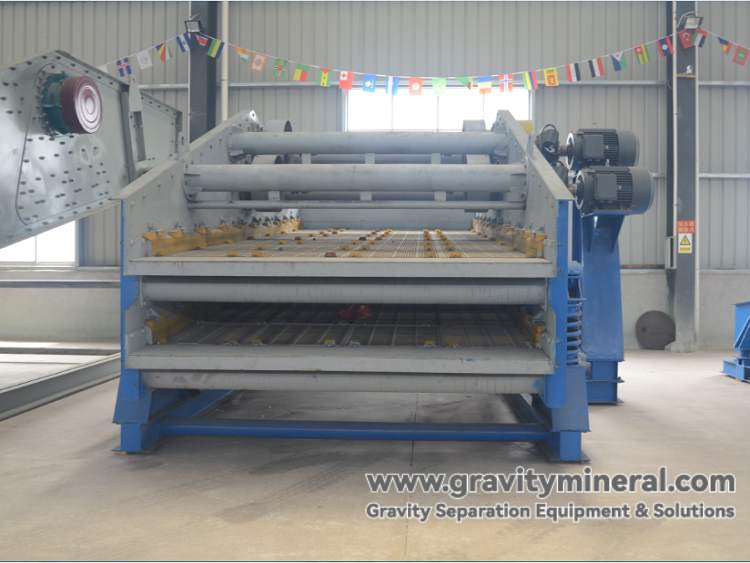
- Stage Two: Rough Concentration. The de-slimed slurry enters the pulsating chute. The fundamental difference between a pulsating chute and a fixed chute lies in the fact that its rubber floor performs high-frequency vertical pulsations, keeping the bed layer consistently loose and preventing it from becoming compacted due to clay expansion.Fixed chutes can become clogged within a few hours under high-silt conditions, whereas agitated chutes rely on mechanical pulsations to maintain a permeable bed, allowing gold particles to settle into the capture zone. The efficiency of this stage in processing high-silt alluvial deposits shows a marked difference compared to fixed chutes.
- Third Stage: Fine-Grain Gold Concentration. This is the technical core of the entire gravity separation process for alluvial gold deposits. The centrifugal separator\'s drum rotates at high speed, creating a centrifugal force environment dozens of times greater than that of a gravitational field.Within this force field, ultrafine gold particles are flung toward the drum wall, while gangue minerals, having a lower specific gravity, are carried by the water flow and discharged through the central overflow. Traditional sluices are essentially ineffective at processing the ultrafine particle size range; the centrifugal separator is the key piece of equipment that fills this gap.
- Section 4: Sweep Selection and Concentrate Purification. The tailings from the centrifugal separator pass through a gold-trapping mat or sweep selection chute to recover any flake gold that was missed.The rough concentrate is fed into a shaking table, where the asymmetrical reciprocating motion of the table surface and water flushing separate the gold from the heavy minerals, producing the final gold concentrate.
From feed to concentrate, this alluvial gold ore gravity separation process does one thing: it allows gold of different particle sizes to settle and separate within their respective force fields.
IV. Why Choose It
Key Points of the Solution: The advantage of this heavy-medium separation scheme for alluvial gold deposits lies not in the sophistication of individual pieces of equipment, but in the closed-loop system it forms across two dimensions: particle size coverage and adaptability to silty ore.
While traditional chute processes rely on “sufficiently coarse gold grains and minimal silt,” this gravity separation solution for alluvial gold deposits puts the initiative back in the hands of the process designer.
V. Applicable Scenarios and Limitations
Key Points: This re-selection solution for alluvial gold deposits has clearly defined application boundaries. Frankly stating its limitations provides greater practical value than exaggerating its scope of application.
- Alluvial or residual alluvial placer gold deposits with relatively high clay content
- Gold grains are predominantly fine and ultrafine, with the ultrafine fraction accounting for a significant proportion
- The ore bodies are dispersed, with a limited service life for individual mining sites; equipment must be capable of being relocated
- Water supply conditions meet the requirements for ore washing, or can be addressed through a closed-loop water circulation system
- Deposits with very low clay content and predominantly coarse gold grains. For such deposits, using a vibrating chute and shaking table is sufficient; installing a centrifugal concentrator would constitute an excessive investment and actually prolong the payback period.
- Ores dominated by coarse, free-standing gold particles with high grades. The advantage of this gravity separation solution for alluvial gold deposits lies in processing fine particles; when coarse particles dominate, the cost-effectiveness is not significant.
- Projects with extremely scarce water resources where the water required for ore washing cannot be secured. Ore washing and desliming are prerequisites; skipping this step will significantly reduce the efficiency of the entire process.
- Projects involving large ore bodies with long service lives. For such projects, it is worthwhile to conduct feasibility studies on flotation or leaching; gravity separation can serve as a pre-concentration stage, but a standalone gravity separation process may not be the optimal solution.
This gravity separation scheme for alluvial gold deposits is not a universal solution. It addresses only two issues: gold trapped in clay and fine-grained gold carried in the tailings. If the gold is embedded in sulfides or gangue and is difficult to liberate, that falls within the scope of grinding and flotation, and gravity separation cannot serve as a substitute.
VI. Implementation
Key Points of the Plan: From ore sample testing to achieving stable performance indicators, this gravity separation plan for alluvial gold deposits proceeds in four steps, each with potential issues that must be addressed in advance.
- Step 1: Collect representative ore samples and conduct ore washing and gravity separation tests. Do not skip the testing phase and proceed directly to equipment selection. The clay content and clay properties of alluvial gold deposits may vary even within the same mining area across different sections.Collect representative ore samples, measure the silt content and gold particle size distribution, and conduct exploratory washing and gravity separation tests. The objective is to determine the degree of siltation in the ore and the proportion of fine-grained gold, thereby providing a basis for equipment selection.Ore sample testing is a fundamental step in selecting a gravity separation scheme for alluvial gold deposits; any equipment selection made without experimental data lacks reliability.
- Step 2: Determine equipment specifications based on processing capacity, allowing for a margin of safety. The processing capacity of ore washing equipment is calculated in wet metric tons, not dry metric tons. The number of agitated chutes should be configured according to the feed rate for roughing; it is recommended to allow for a certain margin of safety.The processing capacity of a centrifugal concentrator is directly related to the drum specifications. When selecting a model, it is essential to clarify the calibrated processing capacity under target recovery rate conditions; one should not rely solely on the maximum value listed on the nameplate. Engineers become involved at this stage to determine the process flow and equipment list. Equipment selection for common ore types is relatively quick, while complex ore conditions require multiple rounds of refinement.
- Step 3: Installation and Commissioning—Focus on the ore washing section and centrifuge parameters. After the equipment is in place, run the ore washing section first to observe the amount of slurry carried away by the gravel and the condition of the undersize slurry. If the ore washing process is not properly adjusted, achieving subsequent performance targets will be impossible.For the centrifugal mineral separator, three key parameters must be adjusted: drum rotation speed, feed concentration, and backwash water pressure. Insufficient rotation speed prevents fine-grain gold from being separated; excessive concentration causes the bed to become compacted; and backwash water pressure that is too high reduces concentrate grade, while pressure that is too low hinders concentrate discharge.Local installation workers can be organized on-site, while engineers remain on-site to provide technical briefings and guidance on core equipment, balancing installation quality with labor costs.
- Step 4: Operate at full capacity and take samples to verify performance metrics. After stable operation is achieved, conduct a full-process sampling assessment, taking samples for analysis from the feed, rough concentrate, centrifuge concentrate, shaking table concentrate, and final tailings.Calculate the roughing recovery rate, centrifuge recovery rate, and the overall recovery rate of the entire line. If the overall indicators deviate significantly from the design values, prioritize re-examining the ore washing section; in most cases, the problem lies in the slime not being washed clean, rather than the centrifuge itself.
The key to successfully implementing this gravity separation scheme for alluvial gold deposits lies not in equipment procurement, but in whether the three stages—testing, equipment selection, and commissioning—form a closed-loop process.
VII. Common Misconceptions
Key Points of the Plan: There are several common misconceptions in gravity separation projects for alluvial gold deposits; identifying them early can help avoid detours.
Gravity separation is effective only for minerals with distinct density differences and good liberation. In alluvial gold deposits where gold is encapsulated by sulfides or gangue, gravity separation cannot resolve the liberation issue; combined flotation or leaching processes are required. To determine whether a gravity separation plan is suitable for an alluvial gold deposit, first assess the state of gold occurrence.
Alluvial gold deposits across different mining areas vary significantly in clay content, gold particle distribution, and clay properties; therefore, recovery rates cannot be compared across different sites. The performance of the same alluvial gold gravity separation scheme may differ significantly from one mine to another; the basis for evaluation should be the test data and commissioning results specific to the mine in question.
Low efficiency in the gravity separation of alluvial gold deposits is rarely due to a single piece of equipment; rather, it is often caused by misalignment in the configuration of processing stages, grain size transitions, and production capacity matching. The compatibility of interfaces between equipment and the alignment of production capacities are just as important as the quality of the equipment itself.
Finalizing a gravity separation process for alluvial gold deposits without conducting ore sample tests constitutes a blind investment. The selection of gravity separation equipment relies heavily on three parameters: density difference, particle size distribution, and clay content; without test data, the selection process lacks a solid foundation.
VIII. Summary of the Proposal\'s Value
Key Points of the Proposal: The value of this gravity separation proposal for alluvial gold deposits can be summarized across four levels.