







Is the recovery efficiency of dendritic gold low? This process boosts both recovery rate and purity.
The gravity separation of dendritic gold is an often-underestimated challenge in the gravity separation stages for both placer and vein gold. Unlike granular gold, which behaves predictably on a shaking table—sinking to the bottom, forming layers, and being trapped by the bed bars—Its branched structure undergoes morphological changes during grinding and beneficiation; flaky and fine-grained particles are carried away with the overflow, resulting in persistently high tailings grades and an inability to increase concentrate grades.Many processing plants attribute the problem to “gold particles being too fine,” but replacing equipment or adding chemicals yields only limited results. In reality, the root cause of low recovery efficiency for dendritic gold often lies in three key areas: protection of the grinding morphology, the equipment\'s capture window, and the intensity of the concentrate processing.
This article is organized into five sections—“Symptoms—Causes—Solutions—Implementation—Results”—and provides a set of practical, verifiable process adjustment strategies addressing real-world production challenges in the gravity separation of dendritic gold.
I. Typical Manifestations of Low Dendritic Gold Gravity Separation Efficiency
First, compare the following three on-site phenomena to determine whether the problem exists.
Persistently high tailings grade, narrowing room for adjustment. The tailings grade from the gravity separation process remains at a high level over the long term. After adjusting the feed rate, water flow, or bed angle, improvements in performance metrics are limited, and the issue may even recur. This indicates that the gravity separation equipment is insufficiently capturing a specific type of gold particle in the current feed.During the grinding process, the branches of dendritic gold break off and the fracture surfaces are flattened, forming flake-like and fine-grained particles. Their settling behavior differs significantly from that of granular gold, making it difficult for conventional gravity separation parameters to effectively account for them.
The concentrate grade is relatively low, placing an increased burden on the final concentration stage. The coarse concentrate from gravity separation contains a high proportion of intergrown particles; dendritic gold branches are often coated with gangue or intergrown with sulfides, preventing the concentrate grade from meeting expectations.To improve grade, it is often necessary to increase the number of selective beneficiation passes or intensify the washing process; however, during this process, fine, flaky gold particles that have already entered the concentrate are prone to being stripped away again, resulting in a secondary loss of metal content.
The process indicators are highly sensitive to operational fluctuations. Even minor changes in feed rate or concentration can cause significant fluctuations in tailings grade. Differences in indicators between operating shifts are difficult to eliminate through “standardized operations.” This reflects the process\'s limited adaptability to the dendritic gold morphology and the lack of a stable capture window.
II. Causes of the Problem: Constraints at Three Levels
Morphological destruction during the grinding stage. Dendritic gold in the ore exhibits an irregular, branched structure and is structurally fragile.The impact and grinding action of steel balls in the ball mill cause the branches to fracture and the fracture surfaces to be flattened, transforming the gold particles from a dendritic to a flake-like or even scale-like form.Relevant studies indicate that coarse gold particles undergo a “re-forging phenomenon” during grinding: they first become equiaxial and are then flattened into flakes. The terminal settling velocity of flake-shaped gold in gravity separation equipment differs from that of granular gold of the same weight; shaking tables and sluices are inherently less effective at recovering flat particles.Losses result from equipment parameters not being adjusted to account for these morphological changes.
The sensitivity of gravity separation equipment to particle shape has been underestimated. While density differences form the basis of gravity separation, particle shape also significantly affects separation efficiency.The movement of flake gold on the shaking table surface differs from that of granular gold, and its centrifugal settling path in spiral chutes also varies. If the shaking table stroke and frequency are still set according to standards for processing granular gold, flake gold will either be carried away by the water flow or mixed into the concentrate as intergrown particles, thereby lowering the grade.The capture window of a single jig or chute does not adequately cover the wide particle size range and flaky material resulting from the fragmentation of dendritic gold.
Over-processing in the fine-selection stage causes secondary losses. Intergrown particles in the coarse concentrate of dendritic gold are subjected to repeated flushing during re-selection. After multiple fine-selection cycles, branched particles are more prone to fracturing and detaching, resulting in excessively high grades in the fine-selection tailings and increased return volumes, which create a circulation burden.Increasing the number of fine-selection stages to raise grade actually releases the metal that has already been captured back into the process. The principle for fine-selection in the gravity separation of dendritic gold should be “prioritizing yield” rather than pursuing the maximum grade of a single concentrate.
III. Solutions: Shape-Preserving Grinding, Broad-Range Capture in Gravity Separation, and Gentle Treatment in Fine Grading
Grinding Stage: Reducing Morphological Damage
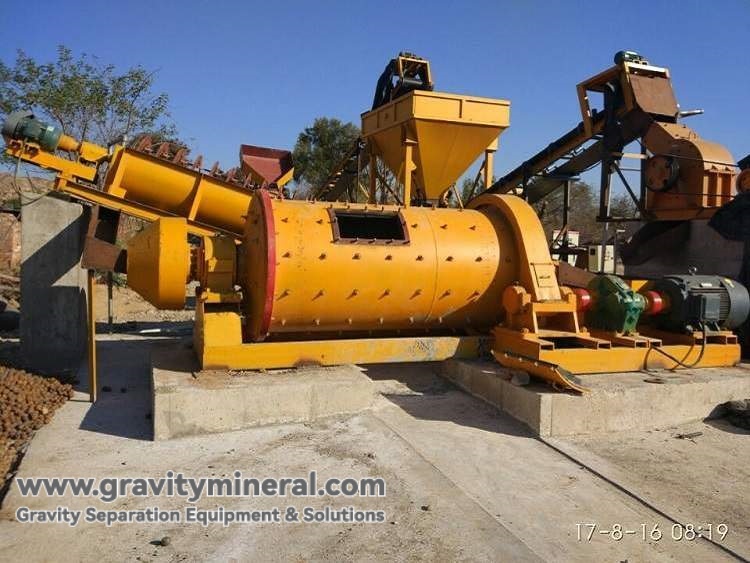
Adjust the steel ball ratio in the primary grinding mill by appropriately reducing the proportion of large balls and increasing the proportion of medium balls, thereby relatively enhancing shear action and reducing impact during the grinding process. While the target fineness remains unchanged, the degree of flattening of gold particles is reduced.Install a grid screen or check screen at the mill discharge to intercept liberated coarse gold particles as early as possible and direct them to the gravity separation process, thereby reducing their circulation time in the grinding circuit. The shorter the residence time of gold particles in the mill, the more intact their dendritic structure remains, and the easier it is to capture them in subsequent gravity separation.
Gravity Separation Section: Centrifugal Roughing Combined with Shaking Table Sweeping
Install a centrifugal separator in the grinding circuit to process the sand from the hydrocyclone or the mill discharge, utilizing the centrifugal force field to enhance the capture of fine and flake gold.The backwash water pressure of the centrifugal separator is a key adjustment factor: if the pressure is too low, the concentrate will contain more gangue; if the pressure is too high, flake gold will be flushed into the tailings.In practice, start at low pressure and gradually increase it, using the pressure point at which the tailings grade begins to decline and the concentrate output stabilizes as a reference value. A combined process using centrifuge roughing and shaking table fine selection can balance recovery rate and concentrate grade while reducing gold loss in the tailings.
The coarse concentrate from the centrifuge is fed into the shaking table for fine selection. For flake-like particles resulting from the fragmentation of dendritic gold, the shaking table parameters should be set to a combination of short stroke, high stroke frequency, and a gentle lateral slope.Short strokes and high stroke rates increase the chances of flake-like gold being retained by the bed bars, while a gentle slope extends the residence time of the material. The feed concentration is controlled within a moderately low range to prevent particle agglomeration, which would reduce separation accuracy.
Fine Selection Stage: Controlling Processing Intensity
The principle for refining coarse concentrate is “light processing.” If the primary reason for low grade is intergrown ore, run the concentrate through a low-concentration, short-stroke shaking table once to remove obvious high-density gangue.If the grade is affected by fine-grained flake gold, switch to a sluice box or low-intensity manual panning to float away light minerals using minimal water flow and gentle agitation. The goal of the concentrate stage is to preserve the metal already captured, rather than pursuing a one-time, significant increase in concentrate grade.
IV. Implementation of the Plan: Key Points for Phased Execution
Phase 1: Data Analysis and Morphology Confirmation. Retrieve recent assay data for feed, concentrate, and tailings from the gravity separation process, and calculate recovery rates and trends in grade.Take concentrate samples for microscopic examination or petrographic analysis to determine whether the gold particles are primarily granular, flaky, or dendritic in form. The purpose of this step is to identify the primary forms of loss and avoid blind adjustments.
Phase 2: Grinding Parameter Adjustment and Comparison. Adjust the steel ball ratio during a single shift, while simultaneously collecting samples of the feed material for gravity separation and tailings before and after the adjustment for comparison. Observe trends in tailings grade; even if the improvement is limited in magnitude, a positive trend serves as a basis for continuing the process.
Phase Three: Standalone Centrifuge Testing. Integrate a centrifugal concentrator into the grinding circuit for standalone testing, focusing on calibrating the relationship between backwash water pressure and concentrate discharge volume. Record the tailings grade and concentrate yield under different pressure conditions to determine the operating range that balances recovery and enrichment.
Phase Four: Finalization of Shaking Table Parameters and Standardization of Operations. Based on the properties of the centrifugal rough and concentrate, determine the operating parameters for the shaking table—including stroke, stroke frequency, slope, and feed concentration—and create on-site operating cards to minimize operational variations between work shifts. After finalizing the parameters, continuously monitor the stability of tailings and concentrate grades.
V. Expected Results and Applicability Limits
In terms of recovery rates, provided that the grinding morphology is adequately preserved and the centrifuge parameters are matched to the ore properties, the recovery rate of the gravity separation process typically shows a measurable improvement compared to pre-adjustment levels, with a corresponding decrease in tailings grade.The specific magnitude of improvement depends on the proportion of dendritic gold in the ore, the grain size of the gold particles, and the grinding and liberation characteristics; reasonable variations exist among different mines.
Regarding concentrate grade, after controlling the processing intensity in the fine selection stage, metal loss is reduced, and the concentrate grade can be stabilized at a level consistent with the characteristics of the associated ore. While the absolute value of the grade is constrained by ore properties, the completeness of metal recovery holds greater economic significance than the numerical grade value.
In terms of stability, parameter fixation and standardized operations help narrow performance variations between work shifts, thereby increasing the tolerance of gravity separation operations to fluctuations in feed material.
The scope of applicability must be clearly defined: This process adjustment is suitable for scenarios where dendritic gold retains a portion of re-selectable particle sizes (generally 0.05 mm or larger) after grinding. If the grain size of dendritic gold in the ore is too fine, the tailings from the gravity separation process will still require flotation or leaching for residual recovery.In its gravity separation solutions for primary gold deposits, GravityMineral adopts a combined approach of “early gravity recovery + tailings flotation/leaching.” The gravity separation stage recovers as much coarse-grained and flake gold as possible, while the fine-grained fraction is processed by subsequent stages, forming a complete recovery chain.
GravityMineral has specialized in the manufacture of gravity separation equipment and process design for two decades, accumulating comprehensive service capabilities—from mineral processing tests and equipment selection to on-site commissioning—for the gravity separation of dendritic gold, as well as for placer and vein gold.If you need to determine the recovery limits and equipment configuration for the gravity separation stage based on the specific properties of your ore, you can obtain supporting data through mineral processing tests before finalizing the process route.