







Process Flow Chart for a Placer Gold Washing and Concentration Plant: An Integrated Solution for Ore Washing, Sorting, and Gravity Separation
The essence of placer gold processing lies in utilizing the density difference between gold and gangue to separate them in flowing water.Gold particles with higher density sink and are retained, while sand and gravel with lower density are carried away by the water flow. This principle is not complicated, but transforming a process flowchart for a placer gold processing plant into a stable, operational production line has never been a challenge due to the principle itself, but rather due to the coordination and integration of the three key stages: washing, screening, and gravity separation.This article focuses on the process flowchart of a placer gold processing plant, breaking down the design logic of the integrated washing, screening, and gravity separation solutions section by section, and identifying the stages where problems are most likely to arise in actual production.
I. The Basic Framework of a Placer Gold Processing Plant Process Flow Diagram
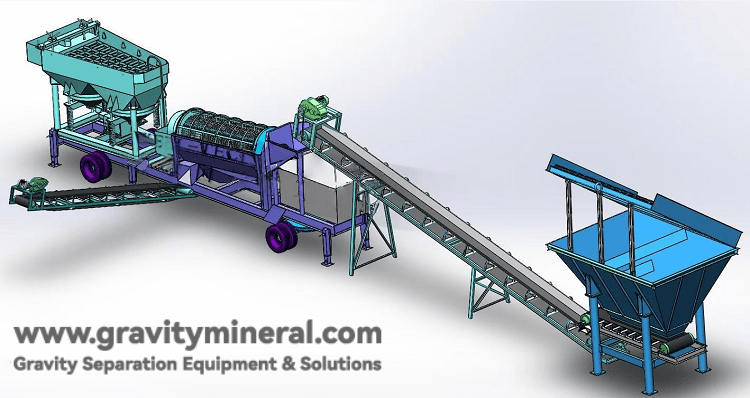
A typical process flow diagram for a placer gold processing plant generally consists of four main stages: feeding, washing and screening, gravity separation (roughing and scavenging), and concentrate beneficiation and dewatering.The feeding stage is responsible for delivering the raw ore uniformly and steadily to subsequent stages; for materials with high clay content and high viscosity, equipment such as trough feeders should be selected to prevent blockages.The washing and screening stage performs two tasks: liberation and classification. It breaks up clay agglomerations while simultaneously removing large, gold-free gravel in advance.The gravity separation section is the core of the entire placer gold processing plant\'s process flow diagram: roughing is responsible for discharging tailings at high throughput; scavenging recovers fine-grained gold from the roughing tailings; and concentrating purifies the heavy sand into qualified gold concentrate. The dewatering section addresses the issues of concentrate transportation and tailings disposal.
The relationship between these four sections is not a simple series connection but rather one of mutual interdependence. If the ore is not thoroughly washed, even the most precise gravity separation section will fail to capture gold particles encased in a mud film; if the screening particle size distribution is mismatched, the mixing of coarse and fine particles will significantly reduce separation efficiency;if the processing capacities of the roughing and scavenging stages do not match, material blockages or equipment idling will occur in the intermediate stages. Therefore, the design of a sand gold processing plant flowchart is essentially a balanced design of the processing capacities and particle size ranges of each stage, rather than a simple stacking of equipment.
II. Ore Washing: The First Critical Stage in the Process Flow Chart of a Placer Gold Processing Plant
A significant difference between placer gold and vein gold is that the gold in placer deposits is already liberated as individual particles and does not require crushing or grinding.However, in riverbed and terrace deposits, gold particles are often coated with a layer of silt or completely encased in clumps of clay. If fed directly into gravity separation equipment, the clay clumps carrying the gold particles will simply roll away, rendering the separation equipment ineffective. The purpose of ore washing is to break up these clay clumps and expose the gold particles.
The selection of ore washing equipment depends on the mud content and viscosity. For materials with low mud content, a trommel screen combined with a spray pipe is sufficient.For materials with high mud content and high粘性, a dedicated cylindrical or spiral ore washer must be configured. Through the rotation of the cylinder and the propulsion of internal blades, combined with water injection at both ends, the mud is agitated and flushed away.In actual projects, it is not uncommon for gravity separation results to be unsatisfactory due to the omission of the ore washing step or insufficient washing intensity; a typical manifestation of this is the presence of undispersed mud clumps in the concentrate.
It should be noted that the determination of washing intensity cannot be applied uniformly. Mud content, the type of clay minerals, and water supply conditions all affect washing efficiency; the same set of parameters may not be applicable across different mining areas. This is one of the reasons why process flow diagrams for placer gold processing plants must be customized based on ore sample data.
III. Screening: The Threshold Determining Feed Size for Gravity Separation
The role of screening in the process flow diagram of a placer gold processing plant is to remove large pieces of waste rock in advance, preventing them from entering the gravity separation equipment, where they would consume processing capacity, increase water consumption, and accelerate chute wear.Placer gold ores are often mixed with cobbles and gravel ranging in size from tens of millimeters to several tens of millimeters. Since these materials contain virtually no gold, removing them early helps reduce the burden on subsequent processing stages.
Setting the screen mesh size requires careful consideration. If the mesh size is too small, coarse gold particles—which are similar in size to gold grains—may be discharged with the oversize material, resulting in losses; if the mesh size is too large, waste rock will not be completely removed, increasing the load on the gravity separation section.A common practice is to set the screen aperture size within the 10–20-millimeter range. Some projects use double-layer screens, with the upper layer intercepting large chunks and the lower layer performing further classification, sending fine particles to the gravity separation stage and discharging coarse particles.Trommel screens are widely used in placer gold processing plants due to their high throughput, strong adaptability to sticky and wet materials, and resistance to screen clogging.
Screening and ore washing are often performed within the same piece of equipment; both cylindrical screens and drum ore washers combine these two functions. This combination shortens the process flow but also requires that both ore washing intensity and screening efficiency be considered simultaneously when selecting equipment—one cannot be prioritized over the other.
IV. Gravity Separation: The Core Segment of the Placer Gold Processing Plant Process Flowchart
The gravity separation section is the core value of the entire sand gold processing plant flowchart. It is typically configured in three stages—roughing, scavenging, and concentrating—to form a relay-style recovery process.
The roughing stage aims to balance throughput and recovery rate. Jigging machines are suitable for processing coarse-grained material; the pulsating water flow causes heavy minerals to sink and light minerals to float, offering high processing capacity and stable operation.Spiral chutes rely on the combined action of centrifugal force and water flow; they consume no power, require minimal floor space, and are suitable for discarding tailings at high throughput rates. Both can be used independently or in combination, depending on the particle size distribution of the gold.
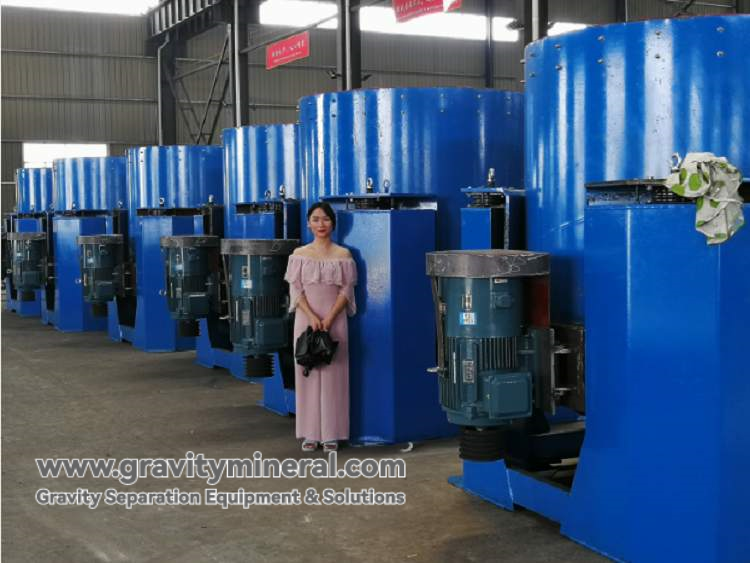
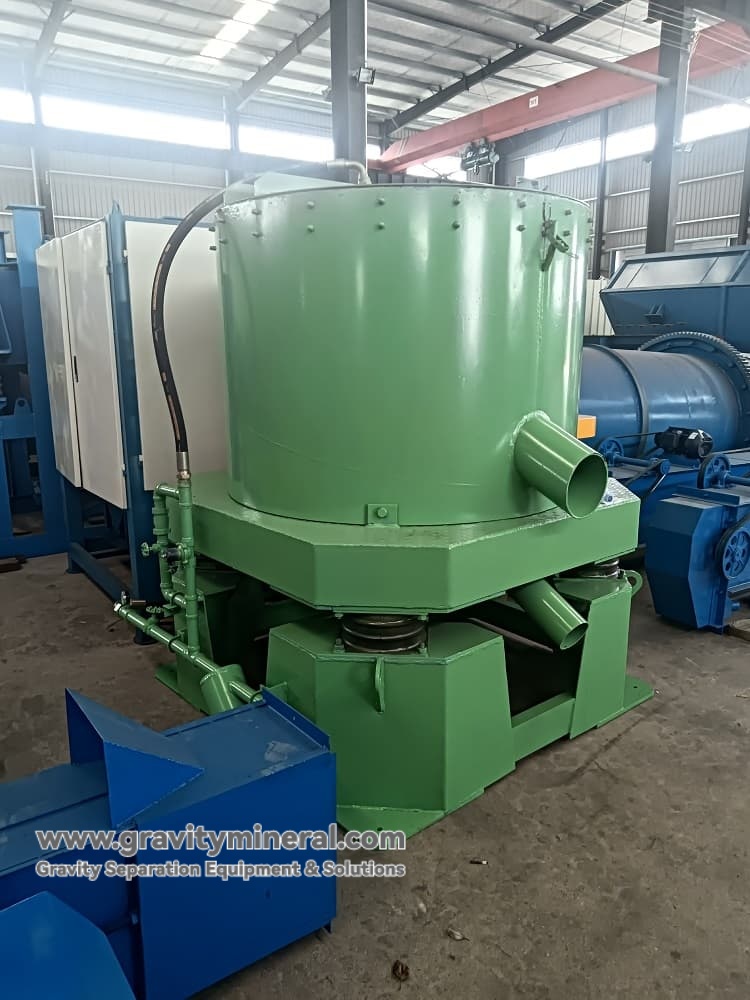
The scavenging stage is designed to recover fine-grained gold from the roughing tailings. The agitating chute uses the periodic agitation of a rubber membrane to keep the bed loose, allowing fine gold particles to enter the chute grids and spike pads; it is a commonly used piece of equipment for placer gold scavenging.Centrifugal ore separators utilize the centrifugal force generated by the high-speed rotation of a drum to enhance the separation of ultrafine gold particles, showing significant effectiveness for fine-silt-grade gold particles that are difficult to recover using conventional gravity separation equipment.Direct discharge of roughing tailings is a relatively common mistake in actual production; the gold grade in tailings is sometimes no lower than that of the original ore, and omitting the scavenging stage directly lowers the overall recovery rate.
The fine-selection stage primarily relies on shaking tables. The table surface is equipped with corrugated bars, which, in conjunction with transverse water flushing, cause the ore particles to spread out laterally across the surface in density-based layers; gold moves toward the concentrate end, while other heavy minerals move toward the intermediate or tailings end.Although individual shaking tables have limited processing capacity, they offer high separation precision and are key equipment for producing high-grade gold concentrate. Further processing of the rough concentrate using a centrifuge or a second shaking table can further improve the concentrate grade.
V. How Mud Content and Gold Particle Size Affect the Process Design
Process flow diagrams for placer gold processing plants are not fixed templates; clay content and gold particle size are the two most significant variables.
For ores with low clay content and predominantly coarse gold particles, the process can be relatively simple: ore screening using a trommel screen, roughing with a jig or spiral chute, scavenging with a pulsating chute, and fine selection with a shaking table. Fewer units are required, and water consumption and operating costs remain manageable.
For ores with high silt content and high粘性, the washing section requires reinforcement; cylindrical or spiral washers cannot be omitted, and multi-stage washing should be employed when necessary. Inadequate washing directly affects the gravity separation section, resulting in low concentrate grades and gold loss in the tailings.
For ores with predominantly fine and ultrafine gold particles, the scavenging stage should be equipped with a centrifugal separator or additional chute sections, and the selection of roughing equipment should favor types that are more effective at recovering fine particles.If the proportion of ultrafine particles is too high, there is an objective limit to recovery achievable through gravity separation alone; therefore, the feasibility of combining gravity separation with other processes must be evaluated.
VI. Common Misconceptions and Limitations of Process Applications
Misconception 1: Gravity separation equipment is universally applicable. Different gravity separation devices have their own specific particle size ranges.Jigging machines excel at processing coarse particles, centrifuges at fine and ultrafine particles, and shaking tables at fine selection. Attempting to recover fine gold using a jigging machine, or using a shaking table for high-throughput roughing, is unlikely to yield the desired results. The value of a sand gold processing plant\'s process flowchart lies in allocating equipment based on particle size, rather than expecting a single machine to handle everything.
Misconception 2: Process flowcharts can be copied verbatim. Process flowcharts for placer gold processing plants available through public channels generally share a similar framework, but there are significant differences in equipment models, screen mesh sizes, water flow rates, and the number of processing stages.Given differences in mud content, gold particle size, processing scale, and site and water/power conditions, the design must be tailored accordingly. Selecting equipment without representative ore sample data carries significant risk.
Misconception 3: Roughing tailings can be discharged directly. Roughing tailings often contain recoverable fine-grained gold; direct discharge not only wastes resources but also increases environmental pressure. The scavenging stage and tailings treatment stage should be considered together during the process design phase.
In terms of applicability, the integrated ore washing, screening, and gravity separation solution is suitable for ore types with low to moderate clay content and a broad gold particle size distribution, such as river sand gold, floodplain deposits, and terrace gravel layers.For ores with extremely high clay content or an excessively high proportion of ultrafine particles, it is necessary to enhance the ore washing stage or evaluate combined processes; it is not advisable to forcefully apply a single gravity separation process.
VII. Key Points for Equipment Integration and Process Implementation
The effectiveness of a placer gold processing plant\'s flowchart largely depends on equipment integration. The stability of the feed equipment directly affects fluctuations in the processing capacity of the ore washing section;the processing capacities of the washing and screening stages must be matched to the roughing stage to avoid overflow or feed interruptions in intermediate hoppers; the production capacities of the roughing and scavenging stages should be coordinated to prevent scavenging equipment from operating at low loads for extended periods; the concentrating stage has a small throughput but requires high concentrate grades, so equipment parameters must be adjusted according to the nature of the feed.
Water management is equally critical. Water used in the washing and gravity separation stages should be recirculated after sedimentation, and makeup water should be controlled based on actual consumption. The flow velocity in chutes and jigging machines must be matched to the feed particle size; excessive flow can wash away fine gold particles, while insufficient flow impedes material conveyance.These parameters must be adjusted during the commissioning phase based on actual on-site conditions and cannot be definitively determined at the design stage.
GravityMineral has accumulated twenty years of experience in the manufacturing of gravity separation equipment and process design. We have the necessary capabilities for all equipment required in a placer gold processing line, including trommel washers, cylindrical screens, jigs,spiral chutes, pulsating chutes, centrifugal separators, and shaking tables required for placer gold processing lines. Based on the results of ore sample tests, we can provide process flow diagrams and equipment configuration plans for placer gold processing plants. For ores with high clay content or very fine gold particles, we can also evaluate the feasibility of combined processing methods using test data.
Conclusion
The core of designing a process flow diagram for a placer gold processing plant lies in clearly defining the task boundaries of the three stages—ore washing, screening, and gravity separation—and then matching equipment and parameters to the properties of the ore. Ore washing determines whether gold particles can be liberated; screening determines the particle size distribution of the feed to the gravity separation stage; and gravity separation determines the final recovery rate.Only when these three stages are properly integrated can the process operate stably. There is no universal template for integrated ore washing, screening, and gravity separation solutions; clay content and gold particle size serve as the starting point for customization, while ore sample data forms the basis for equipment selection—a principle reflected in every stage of the process flowchart for a placer gold processing plant.