







What to Do When Gold Flake Re-processing Efficiency Is Low? Choose the Right Process to Boost Both Recovery Rates and Profits
Low efficiency in the re-processing of flake gold is an unavoidable issue for many gold ore processing plants in actual operation. When shiny flakes are clearly visible in the tailings but recovery rates remain low, many operators\' first instinct is to blame the equipment and simply replace the centrifuge to resolve the issue.In reality, this is often not the case: the efficiency of flake gold gravity separation depends largely on whether the grinding fineness is adequate, whether the gravity separation stages are properly positioned, and whether the process configuration is well-coordinated. In other words, low efficiency in flake gold gravity separation is not a problem with a single piece of equipment, but rather an issue of matching the entire gravity separation process.Only when the process is optimized can both the recovery rate of flake gold and overall profitability improve simultaneously.
Where Exactly Is the Flake Gold Being Lost?
The challenge with flake gold lies in the very word “flake.” Even coarse-grained gold exists in clumps; once it settles in a chute or the conical chamber of a centrifuge, it stays there.Flake gold is different—it has a large specific surface area, so it\'s easily carried away by the water flow and settles much more slowly than granular gold of the same weight. If the flow rate isn\'t controlled properly, the flakes will be carried away with the tailings.
An even more insidious form of loss is entrapment. The gold particles themselves may have been liberated and are flake-shaped with sufficient size, but they are embedded in gangue or intergrown with pyrite, encased in a layer of material. When the centrifuge spins, if the density difference isn\'t great enough, they won\'t be flung into the concentrate ring groove and will instead be discharged along the central discharge channel.A certain gold mine suffered this setback: the gravity concentrate was too coarse, and the middlings and tailings from the shaking table still contained unground, gangue-encased gold particles. No matter how many times the material was recycled through the process, these particles simply could not be recovered.Later, the middles and tailings from the shaking tables were re-ground to liberate the encapsulated gold, which was then sent back to the shaking tables for fine selection. Only then did the recovery rate of flake gold through gravity separation show significant improvement. No equipment was replaced; the solution lay in optimizing the grinding stage.
Another type of loss occurs when the gravity separation equipment is “underfed.” While feeding the grinding overflow directly into the centrifuge may seem correct, the slurry volume is insufficient for the equipment to process, preventing the establishment of a stable enrichment bed within the centrifugal field.By diverting the overflow from the first grinding stage to run the centrifuge in a closed-circuit operation, the load increased, and the separation results improved. Low efficiency in flake gold gravity separation is sometimes not due to faulty machinery, but rather to insufficient feed material for processing.
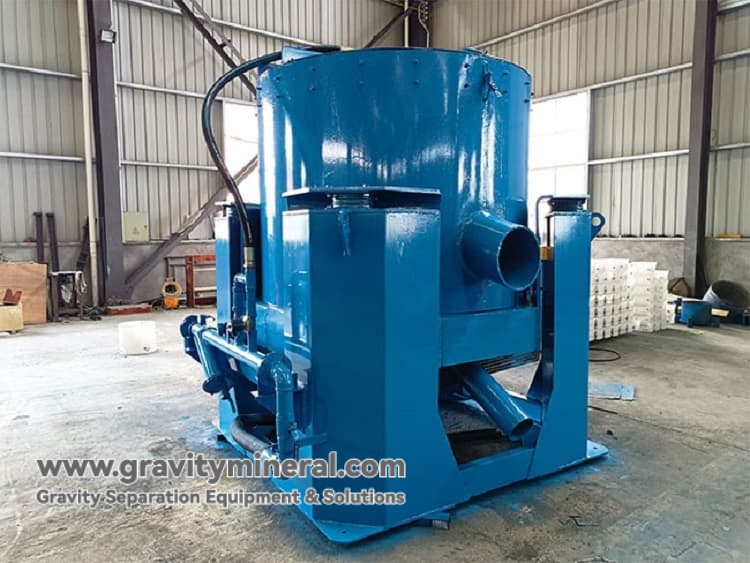
How Does the Centrifuge Retain Flake Gold?
The core function of a centrifugal concentrator is to amplify gravity by dozens of times. Under natural gravity, flake gold and gangue sink down a chute; since the flakes are light, they become disorganized as soon as the water current stirs them.When the centrifuge spins, centrifugal force—which is dozens of times greater than gravity—flings the slurry against the conical wall; the heavier particles cling to the wall, while the lighter ones flow toward the center.
Let\'s use an analogy. Fill a bucket with water, sprinkle in a handful of sand and sawdust, and let it sit; the sand sinks to the bottom and the sawdust floats to the surface—this is gravity at work.If you spin the bucket in a circular motion, both the sand and sawdust are flung against the bucket\'s walls—but the sand clings tightly, while the sawdust scatters at the slightest impact. When a stream of water is forced into the center, the sawdust is washed away first, leaving the sand behind.A centrifuge performs this “spinning the bucket and adding water” action: the backwash water scatters and carries away the lighter minerals, while the heavier minerals get trapped in the annular groove.
Therefore, a centrifuge has only two key parameters: the G-value (centrifugal force multiplier) and the backwash water flow rate. If the G-value is too low, light and heavy minerals cannot be separated;if the G-value is too high, flake gold will also be flung into the tailings—the flakes are too thin, lack sufficient inertia, and are carried away by the water. If the backwash flow is too low, the bed will become compacted, and the concentrate grade will not improve; if the flow is too high, fine flake gold will be washed away directly. There is no one-size-fits-all value for these parameters; you must test them with your own ore.
Adjusting the process is more important than replacing equipment
If gravity separation recovery is low, don\'t rush to replace equipment; reviewing the process flow is often more effective.
The first thing to check is whether the grinding fineness is sufficient. Flake gold is most vulnerable to becoming trapped in gangue. Take a look at the gravity separation tailings under a microscope; if you can still find agglomerated gold particles, it indicates that the grinding process was insufficient. Of course, grinding too finely is also problematic—if flake gold is ground into ultrafine particles, it becomes even harder to capture during gravity separation.The grinding fineness must be maintained within a specific range to ensure gold particles are liberated without being over-ground.
The second key factor is whether the gravity separation point is correctly positioned. Gravity separation excels at early recovery. Once gold particles are liberated, they should be removed immediately—do not allow them to circulate back and forth through the flotation or leaching circuits.Install a centrifuge in the grinding and classification circuit; divert a portion of the hydrocyclone underflow to the gravity separation process. Recover the coarse, free-standing gold on the spot, and send the remainder to subsequent processes. Every additional cycle that flake gold goes through in the process increases the chance of it being ground into finer particles or lost.
Don\'t overload the gravity separation process—that\'s the third point. If the return flow from the grinding circuit is too high, the slurry will contain excessive fine silt and be too concentrated, causing the centrifuge bed to become clogged with silt and leading to a direct decline in separation efficiency. First, improve grinding efficiency and reduce the return flow; only then will the gravity separation process have room to perform effectively.
Do not cut corners on the reprocessing of gravity concentration—this is the fourth point.The grade of concentrate coming out of the centrifuge varies, and direct smelting isn\'t cost-effective; feeding it to a shaking table for further concentration is standard practice. There\'s often valuable material left in the middlings and tailings from the shaking table; regrinding and re-concentrating them—or returning them to the centrifuge—is better than simply discarding them.
Equipment Selection Is Key to a Smooth Gravitational Separation Line
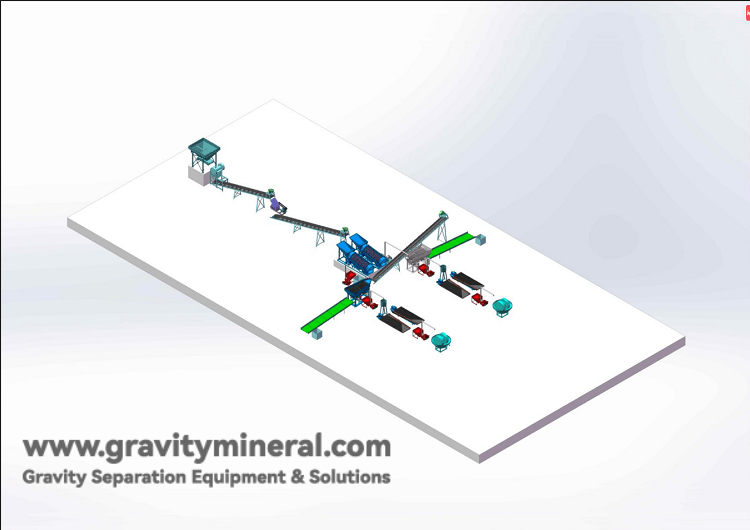
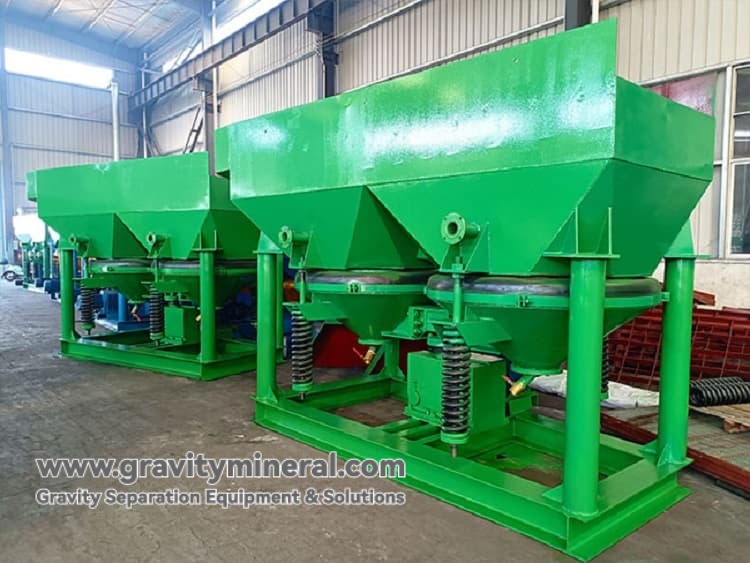
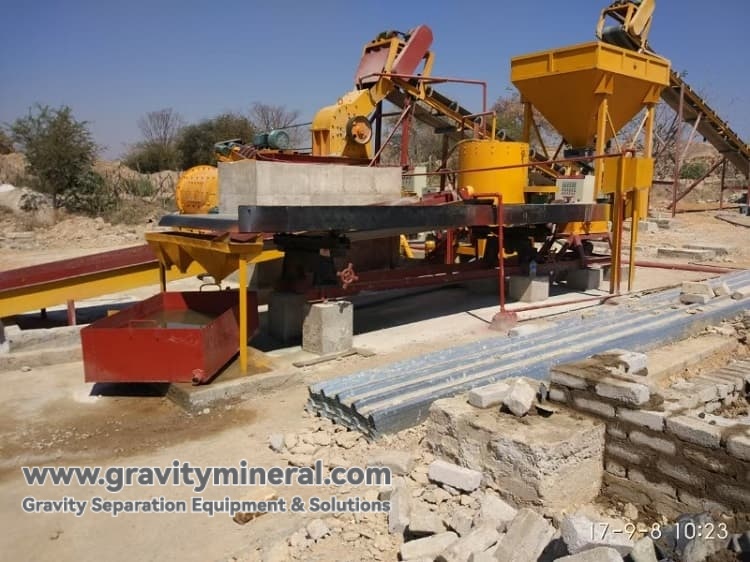
Once the process flow is optimized, equipment selection must not be taken lightly.For a gold concentrate reprocessing line, the core equipment consists of just a few key components: the jig handles the high throughput of the roughing stage; the shaking table ensures the production of qualified concentrate; the centrifugal concentrator specializes in processing the ultrafine particles; and the spiral chute is suitable for handling high-volume, low-grade roughing tailings.For placer gold deposits, a drum washer must be installed upstream to remove the mud; otherwise, the gold particles will be coated in slurry, and no matter how capable the gravity separation equipment is, it won\'t be able to separate them cleanly.
It\'s all too common in gravity separation lines for operators to buy a piece of equipment from one supplier and a set from another—each piece may look fine on its own, but when connected, they conflict. If the jig\'s throughput doesn\'t match that of the subsequent shaking table, the system will either experience material jams or run idle.The particle size coordination in a gravity separation process is particularly sensitive: if coarse particles are recovered, fine particles will all end up in the tailings. This problem is most likely to occur in cobbled-together lines. It is best to have a single team oversee the interfaces, capacity, and particle size matching of the equipment. Only when the entire chain—from feed to concentrate—is seamlessly integrated can the performance indicators for gold recovery remain stable.
A reasonable configuration for rock gold ore involves embedding a jig or centrifuge in the grinding circuit for early recovery; directing the sand from the classifier to the jig for roughing; feeding the rough concentrate to the shaking table for fine selection; and sending the gravity tailings to flotation or leaching as a backup.Placer gold deposits are relatively straightforward: screen the ore using a drum washer, feed the undersize to a jig or spiral chute for roughing, send the rough concentrate to a shaking table, and run the fine particles through a centrifuge for a final pass.For complex ores such as zircon-titanium sand, gravity separation serves only as a preliminary step; magnetic and electrostatic separation must follow to separate titanium from zirconium. If you\'re unsure how to configure your processing plant, conducting a series of beneficiation tests using representative ore samples is far more reliable than deciding on equipment based on guesswork.
When Is Gravity Separation Alone Insufficient?
There is no single magic solution for gravity separation of flake gold. Gold particles in the ore are finely disseminated, with most measuring less than several tens of micrometers, or are closely associated with sulfides; it is not very realistic to achieve high recovery rates relying solely on gravity separation.The strengths of gravity separation lie in its early and rapid recovery at low cost—it extracts what can be recovered first; fine-grained, intergrown, or encapsulated particles are left to flotation or leaching to handle the remainder.
Many gold mines adopt a two-pronged approach: gravity separation is used to produce high-grade concentrate, while the gravity tailings are sent to flotation or carbon-in-leach (CIL) processing. Only by combining these methods can the overall gold recovery rate be maximized. Therefore, do not expect gravity separation to handle the entire process on its own, nor should it be tasked with jobs it cannot perform.The efficiency of gold flake gravity separation hinges on whether it successfully recovers what it\'s designed to recover—not on expecting it to handle everything.
A Few Common Pitfalls
Focusing solely on recovery rate while ignoring concentrate grade is the first pitfall. Reducing the backwash flow will certainly boost the recovery rate, but the concentrate will be full of heavy mineral impurities, doubling the workload for shaking table enrichment and driving up smelting costs. Recovery rate and grade must be considered together.
Copying someone else\'s parameters is the second pitfall. Even if a certain G-value works well for another mine, your ore\'s density composition and gold flake thickness may differ, so the same parameters might be excessive. Conducting batch tests with your own ore is more reliable than simply copying parameters.
Ignoring the shape of flake gold is the third pitfall. Whether the gold in your ore is predominantly flake-shaped or granular requires different processing approaches. Flake gold settles slowly, so the feed concentration must be stable, water flow fluctuations must be minimal, and the chute angle and centrifuge backwash flow rate must be set more conservatively than when processing granular gold.
The low efficiency of flake gold gravity separation ultimately boils down to one principle: ensure that well-liberated flake gold enters the concentrate stream immediately, without giving it a chance to circulate through the process. Grinding, gravity separation points, centrifuge parameters, and concentrate reprocessing—even a slight deviation in any of these steps will result in a significant drop in flake gold recovery.Selecting the right gravity separation process isn\'t about replacing equipment with a more expensive model; it\'s about getting the grinding fineness, process configuration, and equipment integration right the first time. Only then can the efficiency of flake gold gravity separation and overall profitability improve in tandem.