







What to Do When the Recovery Rate for Residual Metal Re-selection Is Low? An Efficient Re-selection Process Can Help You Boost Your Profits
The beneficiation process for residual gold deposits differs significantly from that for alluvial gold. After primary veins have weathered and disintegrated, gold particles remain in place or are displaced only a short distance; their edges remain unrounded and are often embedded in weathered rock fragments and clay lumps, resulting in a generally high clay content.When processing this type of ore using the conventional configuration of fixed sluices combined with shaking tables, some coarse-grained gold can still be recovered, but fine-grained gold and gold entrapped in mud are easily lost with the tailings.
What can be done about low recovery rates in the gravity separation of residual gold? In most cases, the problem lies not with the equipment itself, but with an ill-defined process sequence. Inadequate desliming, failure to separate particle sizes, and a disconnect between roughing and scavenging—if any of these three steps is problematic, performance indicators will remain unstable no matter how precisely the parameters of subsequent equipment are adjusted.The following section outlines the process logic and key configuration points for an efficient gravity separation process, taking into account the material characteristics of residual ore.
I. Where Does the Problem Typically Lie in Low Recovery Rates for Residual Gold Re-selection?
The material characteristics of residual ore mean that standard placer gold processing methods cannot be directly applied. High clay content, a wide range of gold particle sizes, and a complex mix of associated heavy minerals—the combination of these three characteristics places more stringent demands on the gravity separation process than those for ordinary placer deposits.
Clay content is the first hurdle. When clay minerals swell upon contact with water, the viscosity of the slurry increases, making it difficult to establish sedimentation and stratification within the gravity separation equipment. No matter how high the specific gravity of the gold particles is, they cannot sink if they are buoyed by the slurry.If the clay content is not properly controlled before entering the gravity separation process, the separation efficiency of subsequent jigging, centrifugation, and shaking table operations will be compromised.
Particle size distribution is the second hurdle. In residual deposits, coarse visible gold coexists with fine-grained gold, making it difficult for a single piece of equipment to cover the entire particle size range. Jigging machines are effective for coarse particles but have limited recovery capacity for fine particles; centrifuges excel at processing fine particles, but feeding material that is too coarse affects separation stability.Directly mixing the feed without prior classification often results in incomplete recovery of coarse particles and failure to retain fine particles.
The disconnect between roughing and scavenging is the third hurdle. The tailings discharged after roughing still contain recoverable fine-grain gold; if scavenging operations fail to capture this portion of the gold, recovery losses will be ongoing.Some sites focus their attention on roughing equipment while neglecting the configuration of the scavenging stage, resulting in persistently high tailings grades without a clear explanation.
These three issues correspond to three solutions: enhancing ore washing and desliming, configuring equipment by particle size, and establishing a closed-loop system between roughing and scavenging. The framework of a high-efficiency gravity separation process is built precisely around these three points.
II. The Core Logic of the High-Efficiency Gravity Separation Process
The core logic of the residual gold gravity separation process can be summarized in four stages: de-sliming, classification, roughing, and fine scavenging. Each of these four stages plays a distinct role; the process is incomplete without any one of them.
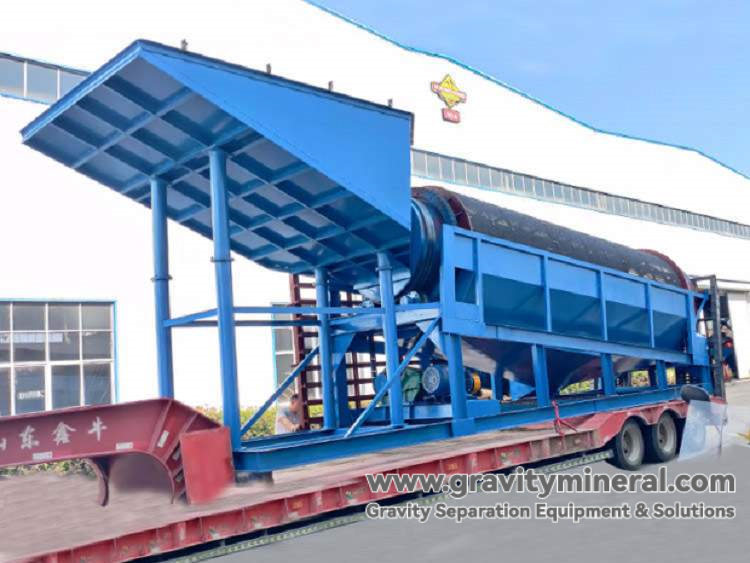
Dewatering is the prerequisite. A drum ore washer, combined with high-pressure water flushing, breaks up and disaggregates clay agglomerations; for ore sections with excessively high clay content, a scrubber is connected in series after the ore washer to use the mutual friction between high-concentration materials to strip the clay film from the surface of gold particles.The goal of the desliming process is to reduce the clay content of the feed material entering the gravity separation stage to a low level, thereby creating conditions for subsequent classification.
Classification is the foundation. The de-slimed material is divided into two streams—coarse and fine—based on particle size; the coarse stream enters the jig, while the fine stream enters the centrifuge. Classification equipment may include a spiral classifier or a hydrocyclone; the classification efficiency directly affects whether the feed size for the two gravity separation units meets the requirements.
Roughing is the enrichment stage. The jig is responsible for the rapid rejection of tailings and enrichment of coarse-grained material. The recovery rate is kept relatively low to remove a large amount of lightweight gangue, while the heavy mineral concentrate is sent to the scavenging stage. The roughing section handles a large throughput and adapts well to fluctuations in feed material, serving as the main processing unit of the flow sheet.
Scavenging serves to capture residual material and enhance purity.Centrifuges process the tailings from the jig and the fine-grained material in the classification overflow, capturing the ultrafine gold particles that would otherwise be lost with the water; shaking tables perform the final concentration on the heavy sand concentrates produced by the roughing and scavenging stages, using the reciprocating motion of the bed surface and lateral water flow to separate gold from associated heavy minerals.The middlings from the shaking table are returned to the front end, forming a closed-circuit process.
Only when these four stages are connected in series do they constitute a complete heavy-medium separation process for residual gold. If any stage is missing or parameters are mismatched, the recovery rate of residual gold will be affected.
III. Step-by-Step Description of the Process Flow
Equipment specifications can be adjusted based on daily processing capacity, but the process structure remains essentially the same. The functions and key configuration points of each stage are described below in the order of operation.
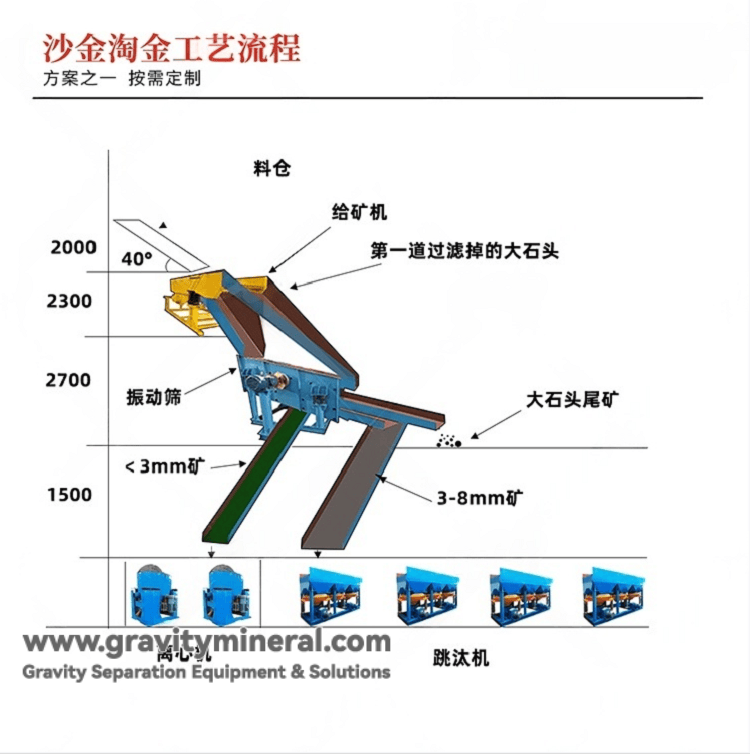
Feeding and Pre-screening. A vibrating feeder equipped with a bar screen first removes large pieces of waste rock. Since alluvial ore contains a significant amount of weathered rock, pre-screening reduces unnecessary wear and energy consumption in the ore washer. The undersize material is uniformly fed into the ore washing operation.
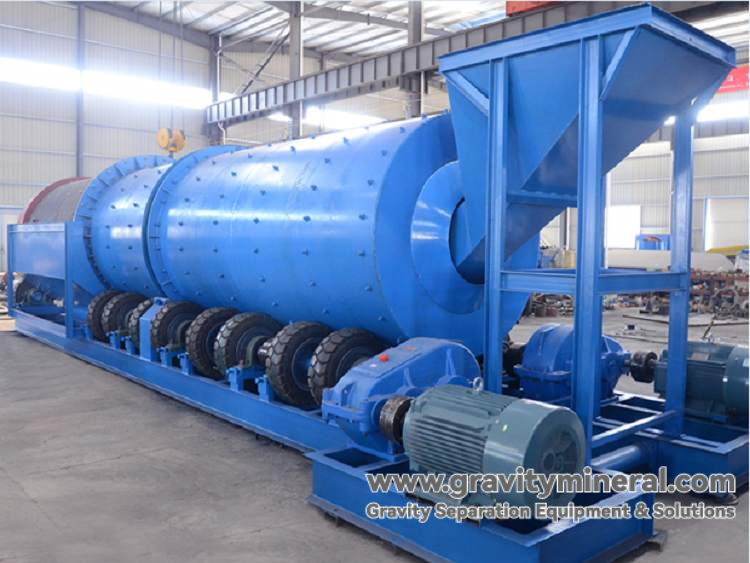
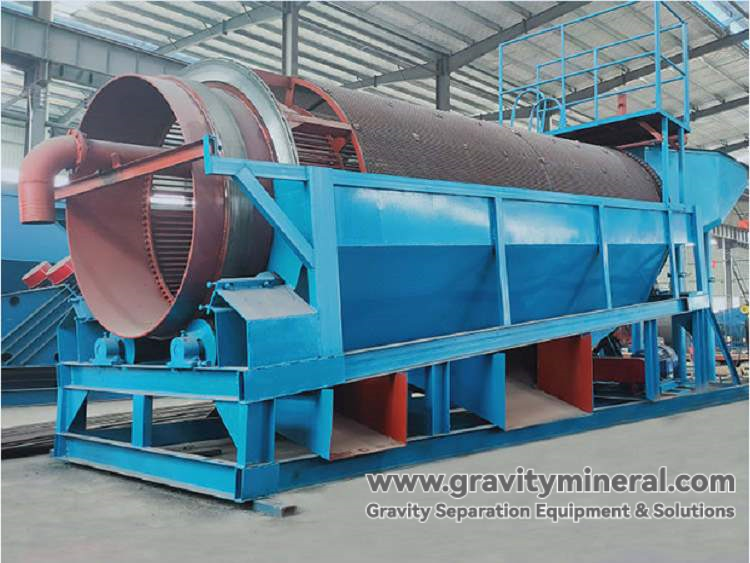
Ore Washing and Desliming. A trommel washer is standard equipment, equipped with high-pressure water jets inside the drum. For ore sections with high mud content, a scrubber is connected in series after the trommel washer. The washed slurry enters a spiral classifier or hydrocyclone to complete secondary desliming and particle size classification.Coarse sand proceeds to gravity separation, while fine slime is directed to the tailings water treatment system.
Coarse-Grain Rough Concentration. The graded coarse-grain material is fed into the jig. The jig\'s stroke and frequency are adjusted according to the feed particle size: a long stroke and low frequency are used for coarse grains, while a short stroke and high frequency are used for fine grains. The jig concentrate is sent to the shaking table for fine concentration, and the jig tailings are fed into the centrifuge for scavenging.
Fine-Grain Sweep. The centrifuge processes fine-grain material from the jig tailings and the classification overflow. The feed concentration and discharge cycle are set based on the properties of the material; the concentrate is merged with the jig feed, and the tailings are sent to tailings treatment. The centrifuge is the key equipment for controlling the final tailings grade.
Refining and Purification. The jig concentrate and centrifuge concentrate are combined and fed into the shaking table. The bed slope, stroke, and transverse water flow of the shaking table must be operated by designated personnel or have their parameters locked to ensure stable separation accuracy. The shaking table concentrate serves as the final gravity concentration, while the middlings are returned to the preceding processing stage.
Tailings and Water Treatment. The fine slurry water generated during desliming is fed into a thickener where flocculant is added to facilitate settling; the underflow is filter-pressed into sludge cakes for dry disposal, while the overflow is recycled to the ore washing machine. The water treatment system should be incorporated into the process design phase to avoid the need for retrofitting after the production line has begun operation.
IV. Key Considerations for Equipment Configuration and Selection
The core principle of equipment selection is to assign each piece of equipment the task it performs best. The following outlines the configuration guidelines and key considerations for major equipment by processing section.
| Process Stage | Main Equipment | Selection Considerations |
|---|---|---|
| Feeding and Pre-screening | Vibrating Feeder (Bar Screen) | Screen bar spacing is determined based on the size of the waste rock; feed uniformity affects the stability of subsequent operations |
| Ore Washing and Desliming | Trommel Washer, Scrubber | The drum wall thickness and the material of the lifting plates determine service life; sections with high mud content should be equipped with a scrubber |
| Classification | Spiral classifiers or hydrocyclones | Classification efficiency determines whether the feed particle size in the coarse and fine streams meets specifications |
| Coarse-Grain Pre-concentration | Diaphragm jig or trapezoidal jig | Use diaphragm jigs for small-scale operations and trapezoidal jigs for larger-scale operations; stroke length and frequency must be adjusted according to particle size |
| Fine-Grain Sweeping | Centrifugal concentrator | The feed must undergo desliming and classification; concentration and discharge intervals should be set according to the properties of the material |
| Enrichment and Purification | 6-S Shaking Table | The concentrate stage prioritizes separation accuracy over throughput; parameters should remain relatively constant |
| Tailings Water Treatment | Thickening tanks, filter presses | Recirculation of overflow water and dry discharge of underflow are critical steps for environmental compliance |
There are several points that are easily overlooked when selecting equipment. Investment in ore washers should not be excessively cut; while using thin plates for the drum may save costs initially, the resulting losses from subsequent part replacements and downtime are often greater.Centrifuges should not process raw ore directly; the feed must undergo desliming and classification, otherwise both separation efficiency and throughput will be compromised. Shaking tables rely heavily on operational experience; frequent parameter changes can cause fluctuations in recovery rates. Assigning a dedicated operator or locking in parameters is a practical approach.
The integration between equipment is more important than the performance of any single unit. Details such as the piping layout for feeding jig tailings into the centrifuge, the method of returning centrifuge concentrate to the shaking table, and the return path for the shaking table\'s middlings all affect the smooth operation of the process. When configuring equipment, it is more meaningful to consider these integration aspects together rather than focusing solely on individual equipment parameters.
V. Which Factors Determine the Final Recovery Efficiency
Even within the same process framework, on-site recovery performance can vary significantly. These variations typically stem from three key factors.
Dewatering efficiency is the first variable. Whether the clay content in the feed material entering the gravity separation process is stable and controlled directly determines the separation conditions for jigging and centrifugation. The water volume for ore washing, scrubbing time, and the classification particle size of the classification equipment must be adjusted based on fluctuations in the actual clay content of the ore; it is not advisable to set these parameters once and leave them unchanged for an extended period.
Grain size matching is the second variable. The cutoff size between coarse and fine particles, as well as whether the feed sizes for the jig and centrifuge fall within their respective high-efficiency ranges, must be determined based on the ore\'s particle size distribution analysis data. If the cutoff size is set unreasonably, both pieces of equipment will operate below their optimal efficiency.
The scavenging configuration is the third variable. The discharge cycle, feed concentration, and backwash pressure of the centrifuge determine the recovery efficiency of fine-grain gold. Only when the scavenging stage operates stably can the final tailings grade be controlled at a reasonable level. If the scavenging stage is neglected, no matter how well the roughing stage is performed, the overall recovery rate will not improve.
The common thread among these three stages is that success does not depend on the performance of any single piece of equipment, but rather on the proper alignment of parameters with the actual feed material. The value of a high-efficiency gravity separation process lies in establishing these optimal relationships during the process design phase, rather than through repeated trial and error on-site.
VI. Key Points for the Engineering Implementation of Residual Gold Gravity Separation Processes
Once the process framework is established, there are several aspects worth considering in advance during the engineering implementation phase.
Fluctuations in ore properties are common in residual ores. The clay content and gold particle size distribution may vary significantly between different ore sections within the same mining area; therefore, the process design should allow for adjustment: the stroke and frequency of the jig should be adjustable, the slope of the shaking table should be adjustable, and the discharge cycle of the centrifuge should be adjustable.Incorporating these adjustment margins into equipment selection will significantly improve adaptability after production begins.
Test data forms the basis for equipment selection. The three parameters of residual ore—density difference, particle size distribution, and clay content—directly determine the choice of equipment and the number of process stages. Selecting equipment without data from representative ore samples carries a high risk. It is recommended to complete particle size composition analysis and recoverability tests before process design, using actual measurement data to support equipment selection decisions.
Operator training during the installation and commissioning phase is equally important. Although gravity separation equipment has a relatively simple structure, it is quite sensitive to operating parameters. A single-step misadjustment of the jig stroke or a slight increase in the lateral water flow on a shaking table can cause fluctuations in recovery rates. Clearly explaining the logic behind parameter settings to operators during the commissioning phase will better ensure the stability of performance indicators after production begins.
Retrofit projects for existing plants can be implemented in phases.If the ore washing or classification stages in the existing process are still functional, they should be retained as a priority; if bottlenecks are concentrated in the absence of a scavenging stage or insufficient precision in the concentrate stage, targeted equipment additions are sufficient—there is no need to completely tear down and rebuild the entire system. Improvements in the recovery rate of residual gold through gravity separation often stem from addressing just one or two key stages.
VII. Common Technical Issues
Is it worthwhile to add a centrifuge when the grade of fine-grained gold in tailings is relatively high?
If the tailings contain free, fine-grained gold, adding a centrifuge for pre-concentration is generally an effective recovery method.Whether the investment is worthwhile depends on a comprehensive assessment of the tailings volume, gold grade in the tailings, and the gold price; as variations between projects can be significant, it is advisable to first conduct a particle size distribution analysis and beneficiation tests before determining the configuration of the scavenging stage.If the gold is entrapped in gangue and has not been liberated, simply adding gravity separation equipment will have limited effectiveness; grinding or other liberation methods should be considered.
The ore washing water is recycled—but how should the fine slurry be treated?
The fine slurry generated during desliming is directed to a thickener for settling; the underflow is processed through a filter press to form a sludge cake for disposal, while the overflow is recirculated back to the ore washing machine. The processing capacity of the thickener and filter press must match the volume of slurry generated during ore washing and desliming; this should be incorporated into the configuration during the process design phase to avoid the need for retrofitting after operations have begun.
The shaker concentrate has an abnormally high sulfur content. How should this be addressed in subsequent processing?
When residual ore contains associated pyrite and arsenopyrite, the higher density of sulfides causes them to be carried into the concentrate along with the gold. If the sulfur content affects subsequent pricing, a magnetic separation or flotation desulfurization process can be added after the shaking table.Magnetic separation is suitable for materials with high magnetite content, while flotation desulfurization is more thorough but increases reagent costs; the specific method should be determined based on an analysis of the concentrate\'s mineral composition.
Ore properties fluctuate significantly—can the process adapt?
During process design, the range of ore property fluctuations and the operational tolerance should be considered, allowing for adjustment margins.Jig stroke and frequency are adjustable, shaking table inclination is adjustable, and centrifuge discharge cycles are adjustable; these adjustment methods can accommodate a certain range of variations in ore properties. If fluctuations exceed the adjustment range, the adaptability limits must be evaluated through comparative testing of different ore samples during the pilot phase, and these limits must be clearly communicated to the on-site team during operational training.